Back to blog
2026 Predictions: The Future of Endpoint Management Is Autonomous
In
Digital Transformation
by
Divya CH

Every few years, endpoint management gets redefined.
New tools. New categories. New promises.
But most of these changes are incremental.
Better visibility.
Faster response.
More control.
2026 feels different.
Not because of a new tool, but because the underlying expectation is shifting.
Endpoints are no longer expected to be managed.
They’re expected to manage themselves.
Prediction 1: Tickets Will Become the Exception
The traditional IT workflow starts with a ticket.
Something breaks.
A user reports it.
IT responds.
This model has lasted because it was necessary.
That necessity is disappearing.
As systems become more capable of detecting and resolving issues on their own, the volume of tickets will decline.
Not because users have fewer problems.
But because those problems never reach them.
The role of IT shifts from handling requests to ensuring systems operate without generating them.
Prediction 2: Visibility Will Be Assumed, Not Valued
For years, visibility has been a differentiator.
Who can see more. Who can detect faster.
That advantage is fading.
Data collection and visualization are becoming standard capabilities.
Every platform can show you what’s happening.
Which means visibility alone will no longer justify investment.
The value shifts to what happens after something is detected.
Execution becomes the differentiator.
Prediction 3: Static Automation Will Hit Its Limits
Most organizations have already introduced some level of automation.
Scripts. Playbooks. Rule-based actions.
These work well in controlled scenarios.
They struggle in dynamic environments.
Endpoints don’t behave consistently enough for static rules to cover all cases.
As complexity increases, maintaining these automations becomes a challenge in itself.
The next phase requires systems that adapt.
Not just execute predefined steps, but determine the right action based on context.
Prediction 4: Endpoint Intelligence Will Move Closer to the User
Traditional monitoring focuses on system-level metrics.
CPU. Memory. Disk.
Useful, but incomplete.
The future of endpoint management will be driven by understanding how systems behave in real usage conditions.
How performance changes throughout the day
How applications interact under load
How user behavior influences system stability
This level of intelligence enables earlier and more accurate interventions.
Before issues become visible.
Prediction 5: Resolution Will Become Continuous
Today, resolution is event-driven.
An issue occurs. A fix is applied.
In autonomous environments, resolution becomes continuous.
Systems are constantly:
Adjusting configurations
Optimizing performance
Correcting drift
Preventing degradation
Not as a response, but as an ongoing process.
The distinction between “working” and “being fixed” starts to blur.
Prediction 6: IT Teams Will Spend Less Time on Operations
As repetitive operational work is reduced, IT teams will shift their focus.
Less time on:
Handling recurring issues
Managing tickets
Performing routine maintenance
More time on:
System design
Security strategy
Business alignment
Innovation
This is not about reducing teams.
It’s about changing how their time is used.
Prediction 7: The Definition of “Healthy” Will Change
Health will no longer be defined by thresholds.
It will be defined by consistency and experience.
A healthy device is not one that meets technical criteria.
It’s one that:
Performs reliably throughout the day
Does not require intervention
Does not generate recurring issues
This shifts the focus from system state to outcome.
Where Nanoheal Fits In
Nanoheal is built around this future.
Not as a layer on top of existing processes, but as a system designed to replace parts of them.
It focuses on:
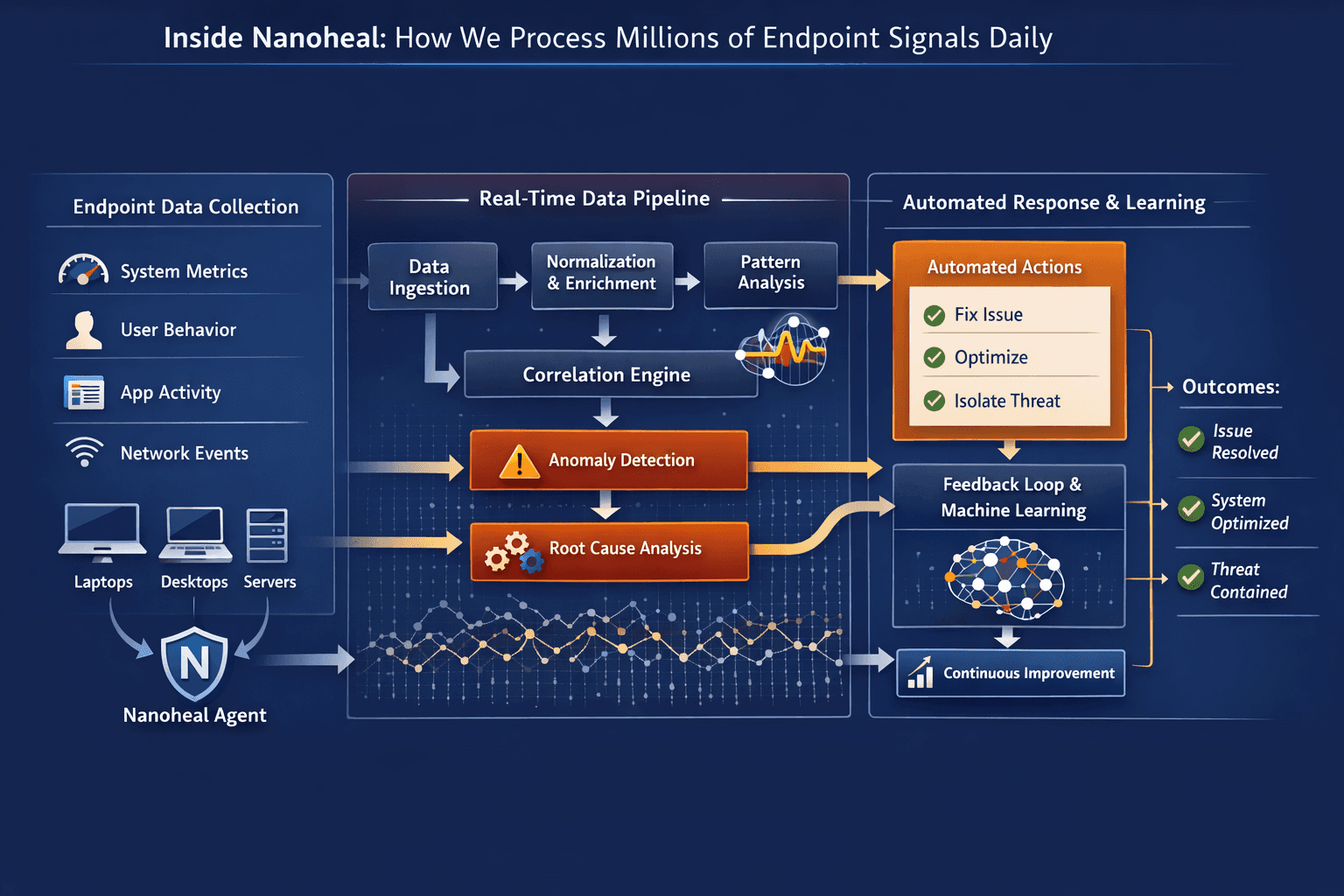
Continuous analysis of endpoint behavior
Early detection of deviations that matter
Autonomous execution of corrective actions
Learning loops that improve over time
The goal is not to assist IT teams in doing more work.
It’s to reduce the amount of work that needs to be done at all.
What This Means for Organizations
The move toward autonomy is not optional.
It’s a response to:
Increasing scale
Growing complexity
Rising user expectations
Organizations that adopt early will operate more efficiently.
Those that don’t will find themselves investing more effort to maintain the same level of service.
Final Thought
The conversation around endpoint management is shifting.
From control to outcomes.
From response to prevention.
From effort to autonomy.
The question is no longer whether this shift will happen.
It’s how quickly organizations will adapt to it.
Because once systems start managing themselves, going back will not feel like an option.