We’ve been spending a lot of time thinking about how Nanoheal gets deployed in the real world.
Not in controlled demos.
Not in ideal environments.
But in actual enterprise setups—where infrastructure is layered, environments are messy, and no two customers look the same.
That’s where partners matter.
Why This Partnership Makes Sense
We’re excited to be working with Juara IT Solutions as one of our partners.
JUARA brings something that’s hard to build quickly, deep, hands-on experience in running and managing IT environments at scale.
They’ve been working across:
Managed IT services
Cloud and infrastructure
End user computing
Cybersecurity
Application and platform support
More importantly, they’ve been doing this across different geographies and operating models. That kind of exposure changes how you approach problems.
You don’t just look at tools. You look at outcomes.
Where Nanoheal Fits In
One of the consistent patterns we see is this:
Most organizations already know where things are going wrong.
They have dashboards.
They have alerts.
They have reports.
What they don’t have is a reliable way to act on that information without adding more operational load.
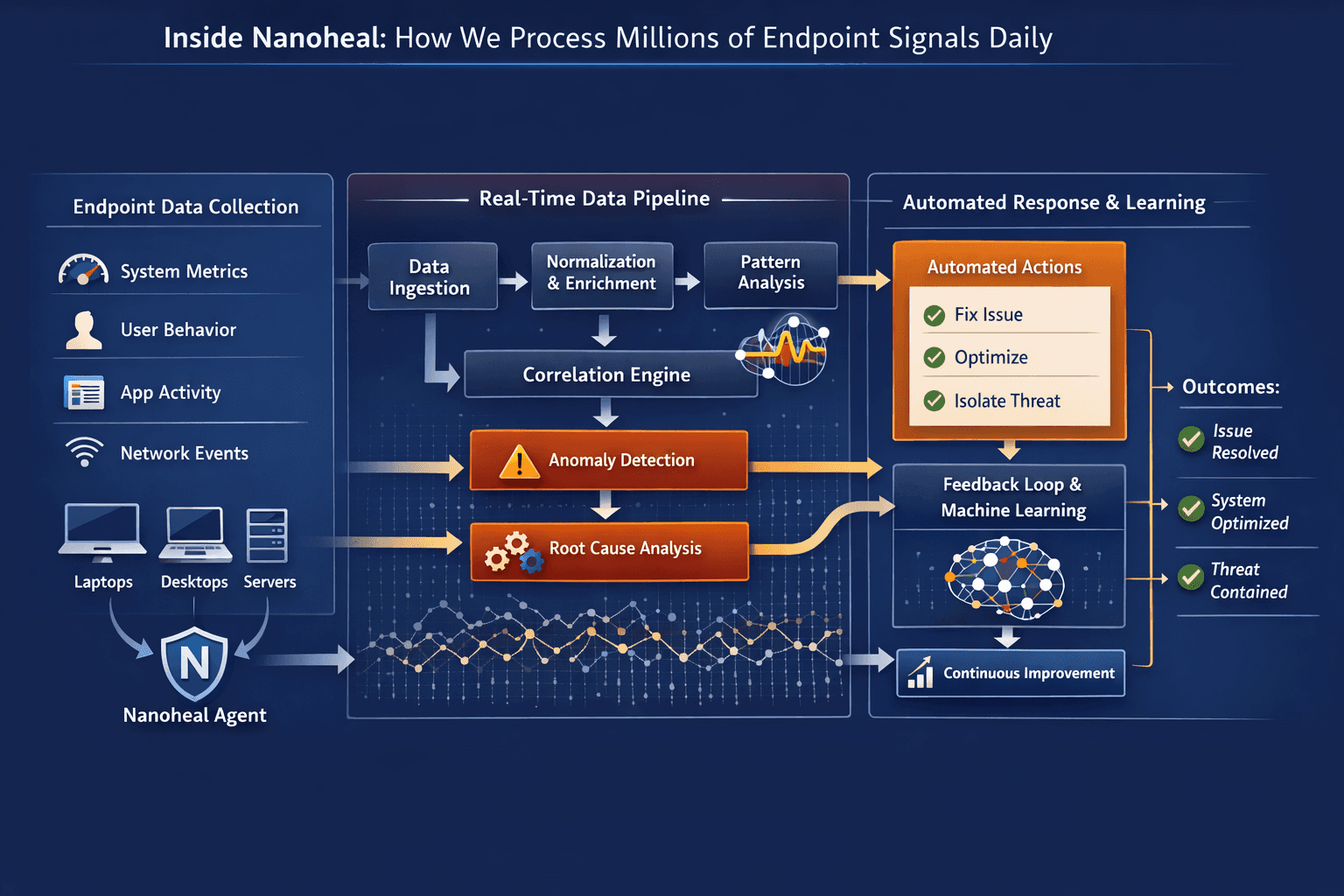
That’s the gap Nanoheal is built to address.
And that’s where a partner like JUARA becomes important.
Because the value of autonomous systems is not just in the technology. It’s in how they get applied, tuned, and scaled in real environments.
From Support to Continuous Operations
In many environments today, IT still operates in a support-driven model.
Something breaks.
A ticket is raised.
Someone fixes it.
That model doesn’t scale well, especially as environments grow.
What we’re seeing instead is a shift toward systems that continuously correct themselves.
Not perfectly. But consistently.
JUARA’s strength in infrastructure operations and service management, combined with Nanoheal’s ability to detect and resolve issues autonomously, creates a more practical path toward that model.
Not theoretical. Operational.
What This Means for Customers
For organizations working with JUARA, this partnership makes a few things easier.
Faster rollout of Nanoheal in complex environments
Better alignment with existing infrastructure and processes
Reduced effort in managing recurring endpoint issues
More consistent digital experience across users
It also means there’s someone who understands both sides—the operational realities and the platform capabilities.
That combination matters more than it sounds.
Building the Right Kind of Ecosystem
We’re not looking to build a large partner list for the sake of it.
We’re looking to work with teams that understand how IT actually runs.
Teams that have dealt with scale.
Teams that have handled edge cases.
Teams that know where things break in practice, not just in theory.
JUARA fits that.
Final Thought
Partnerships only work when both sides bring something real to the table.
JUARA brings deep operational experience.
Nanoheal brings a different way of handling endpoint issues.
Put together, it creates a more practical path toward systems that don’t just report problems, but actively reduce them.
That’s the direction we’re building toward.
And this is a good step in that direction.