Back to blog
Why Your IT Team Is Burnt Out (And What Actually Fixes It)
In
IT Service & Support
by
Divya CH

Burnout in IT rarely looks dramatic.
It doesn’t usually show up as people quitting overnight or systems collapsing.
It shows up slowly.
Delayed responses.
Reduced attention to detail.
A constant sense of being behind.
And eventually, a quiet acceptance that this is just how things are.
The Work No One Talks About
When people think about IT complexity, they imagine large outages or critical incidents.
But that’s not what consumes most of the time.
It’s the repetition.
The same tickets, over and over
The same fixes, applied again and again
The same issues resurfacing across different devices
None of these are individually difficult.
That’s what makes them exhausting.
The Always-On Problem
Modern IT doesn’t really stop.
Alerts come in at all hours.
Systems operate across time zones.
Issues don’t wait for working hours.
Even when nothing major is happening, there’s a constant background load.
Something might need attention.
That low-level vigilance adds up.
When Effort Stops Leading to Progress
One of the more frustrating aspects of IT operations is that effort doesn’t always reduce future effort.
You fix an issue today.
The same issue appears next week.
And again the week after.
There’s no sense of closure.
Just continuation.
Over time, this creates a feeling that the system isn’t improving.
It’s just being maintained.
Alert Fatigue Is Real
Most teams are not short on information.
They’re overloaded with it.
Alerts, logs, notifications, dashboards.
Everything is visible.
Very little is actionable without effort.
So engineers spend time:
Filtering noise
Prioritizing signals
Deciding what actually matters
Before they even begin to fix anything.
The Hidden Cost of Repetition
Repetitive work doesn’t just consume time.
It consumes attention.
And attention is limited.
When teams spend most of their time on predictable issues:
Complex problems get less focus
Preventive work gets delayed
Strategic improvements are pushed out
This creates a loop.
More reactive work leads to less time for improvement, which leads to more reactive work.
Why Hiring More People Doesn’t Solve It
The instinctive response is to add more people.
And in the short term, that helps.
But it doesn’t fix the underlying issue.
If the system continues to generate the same volume of repetitive work, more people just means more people doing the same things.
The model doesn’t change.
The workload just spreads out.
What Actually Changes the Equation
The only meaningful way to reduce burnout is to reduce the amount of work that needs to be done.
Not by working faster.
Not by organizing better.
But by eliminating categories of work entirely.
Specifically:
Recurring issues that have known solutions
Tasks that follow predictable patterns
Problems that can be detected earlier than they are today
Once these start disappearing, something shifts.
The work becomes less reactive.
The pace becomes more manageable.
The system starts to feel like it’s improving.
A Different Way to Operate
In environments where repetitive issues are handled automatically:
Fewer tickets are created in the first place
Engineers are interrupted less often
Attention can be directed toward higher-value work
Systems become more stable over time
The difference is not just operational.
It’s psychological.
The work feels different.
Where This Is Heading
There’s a broader shift happening.
From teams that manage issues
to systems that prevent them
From constant intervention
to continuous correction in the background
From effort-driven operations
to outcome-driven systems
Some organizations are already moving in this direction.
Not by replacing teams, but by changing what the system expects from them.
A Subtle Shift in Approach
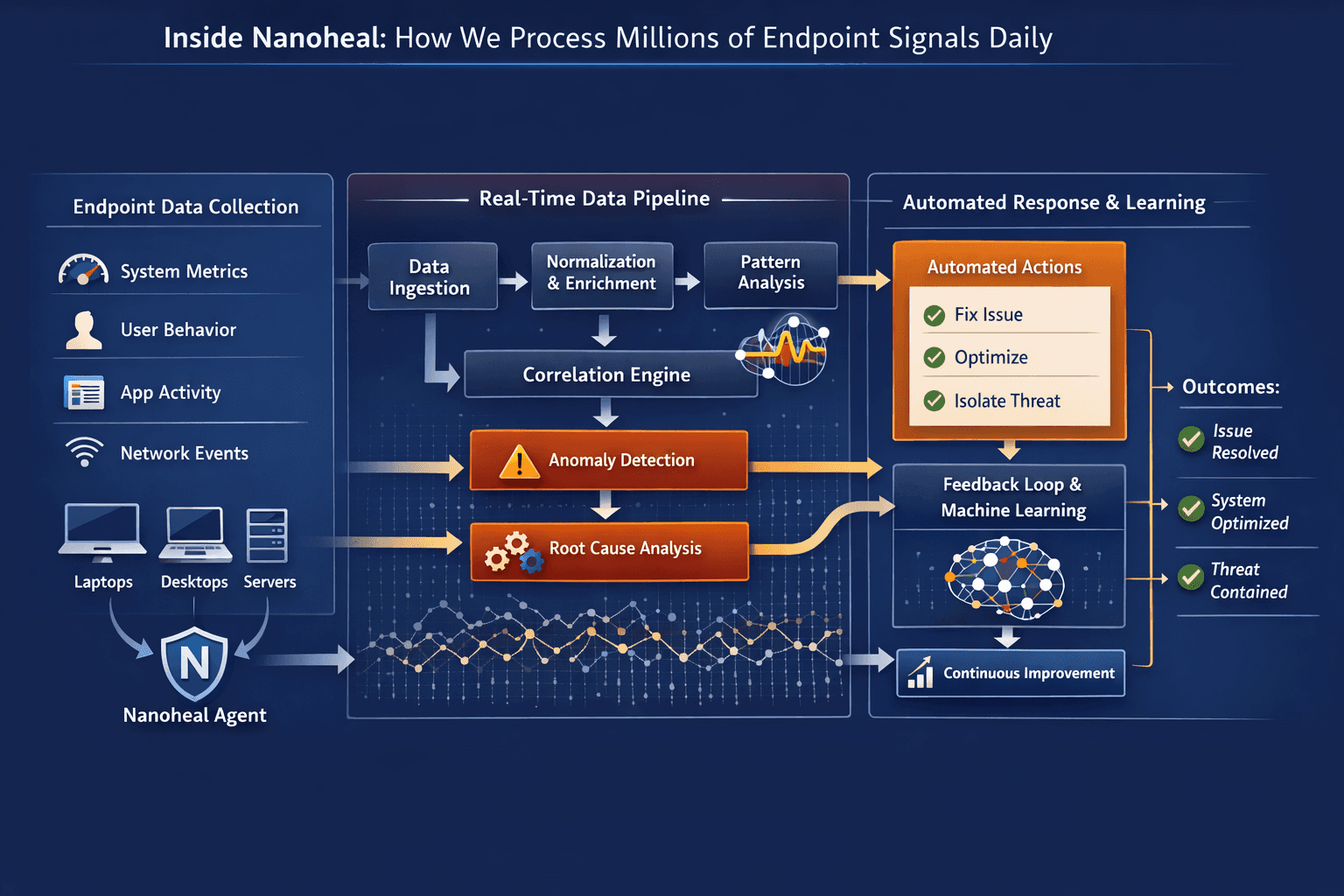
In more advanced environments, endpoint behavior is continuously observed and adjusted.
Patterns are recognized early.
Recurring issues are quietly corrected.
Deviations are handled before they escalate.
Over time, this reduces the volume of work that reaches the team.
Not because issues disappear entirely, but because they are handled earlier and more consistently.
This kind of model doesn’t rely on constant attention.
It reduces the need for it.
Final Thought
Burnout is often treated as a people problem.
In many cases, it’s a system problem.
If the system keeps generating the same work, no amount of effort will fix it.
But if the system starts resolving that work on its own, everything changes.
The workload decreases.
The pressure eases.
The team gets space to focus on what actually matters.
And that’s when IT starts to feel sustainable again.