Back to blog
Nanoheal Integrates Actual Experience to Unite Digital Experience Intelligence with Autonomous Endpoint Operations
In
Press Release
by
Divya CH

Nanoheal, a platform for autonomous endpoint operations and digital experience optimization, has completed the integration of Actual Experience PLC, a UK-based digital experience analytics company acquired early 2025, bringing its technology platform, intellectual property, and core capabilities into a unified system.
This marks an important step in a shift that has been building across enterprise IT for some time.
For years, organizations have been getting better at seeing.
Dashboards improved.
Metrics expanded.
Experience became measurable.
But one gap remained.
Seeing a problem and solving it were still two separate steps.
Why This Gap Matters
Most organizations today already understand where experience is breaking down.
They can identify:
Devices that consistently underperform
Applications that degrade over time
Patterns that affect productivity
But the path from insight to resolution is still manual.
Insight → Ticket → Investigation → Fix
That delay is where inefficiency accumulates.
And more importantly, where user experience suffers.
What This Changes
With the integration of Actual Experience, Nanoheal brings together two capabilities that have traditionally operated in isolation:
Deep digital experience intelligence
Autonomous endpoint operations
This is not about adding more dashboards.
It is about connecting insight directly to execution.
So that understanding a problem leads immediately to action.
From Measurement to Continuous Correction
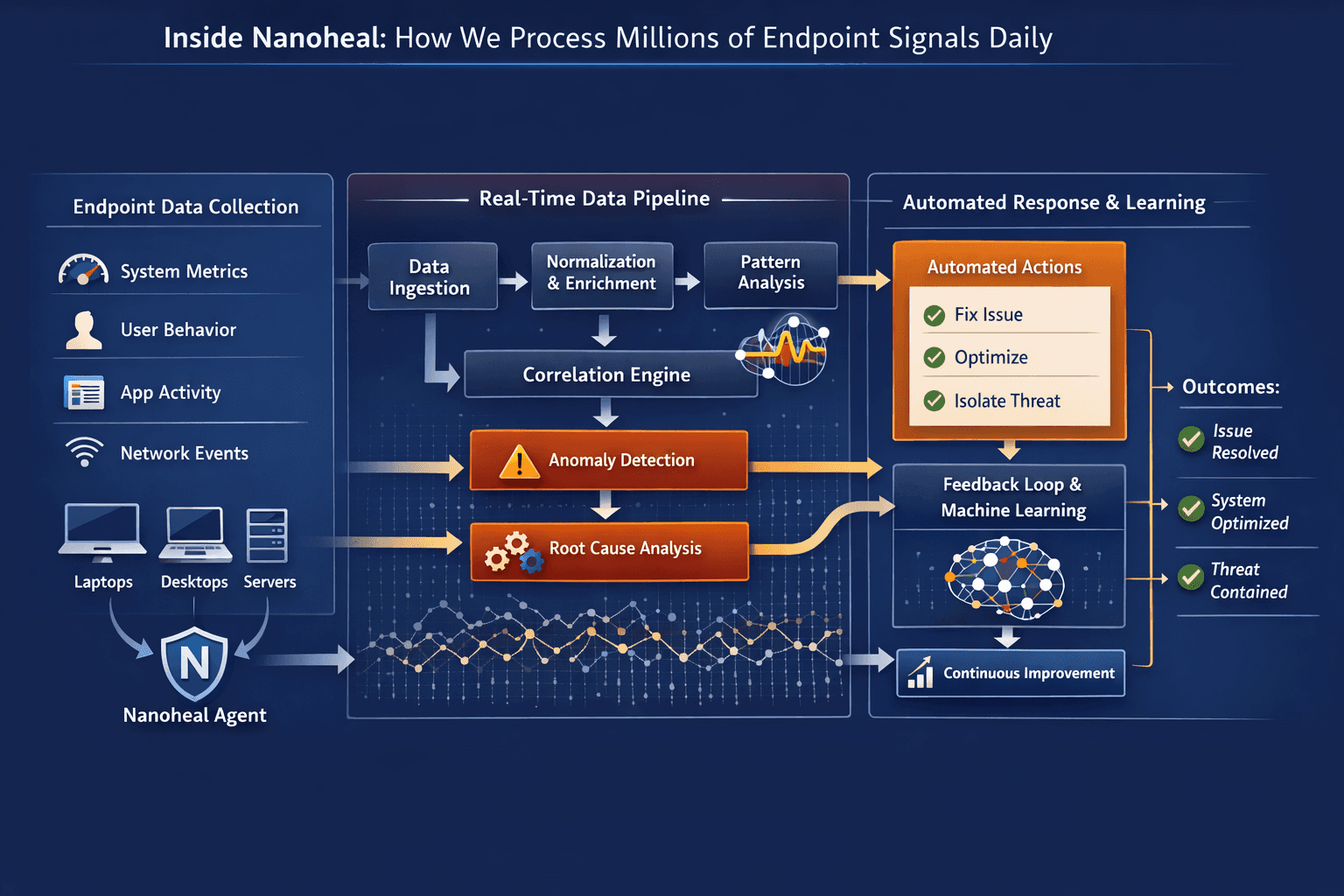
When experience intelligence and autonomous execution operate as one system, the model changes.
Instead of observing and reacting:
Degradation is detected as it begins
Impact is understood in real context
Corrective actions are triggered automatically
Outcomes feed back into the system
Experience is no longer something you measure after the fact.
It becomes something the system continuously maintains.
What This Enables in Practice
This shift has practical implications:
Issues are resolved earlier, often before users notice
Repetitive problems stop resurfacing across environments
Manual intervention becomes less frequent
Experience becomes more consistent across devices and users
The system moves from reporting issues to reducing them.
A More Integrated View of the Endpoint
Endpoints are where experience and operations intersect.
User behavior, application performance, system health, and network conditions all come together here.
Treating these as separate layers creates fragmentation.
Bringing them together enables decisions that are both technically accurate and experience-aware.
Moving Beyond Layered IT
For years, enterprise IT has evolved in layers:
Monitoring.
ITSM.
Observability.
Automation.
Each layer added capability.
None removed the delay between knowing and doing.
This changes that.
It closes the loop.
What This Means for Enterprises
For organizations, the impact is immediate and measurable:
Less time spent interpreting dashboards
Faster resolution of issues that matter
Fewer recurring problems
More stable and predictable digital experience
It also changes how IT teams operate.
Less reactive work.
More focus on improvement and strategy.
A Natural Evolution
This is not a new direction.
It is the next logical step.
From visibility
to understanding
to action
to autonomy
The convergence of experience and execution was inevitable.
Final Thought
The industry has become very good at identifying problems.
The next phase is about systems that act on them.
Without delay. Without escalation. Without repetition.
That is the shift this move represents.
And once that loop is closed, it becomes very difficult to operate any other way.