AIOps has become one of those terms that everyone uses and very few define.
Every platform claims it.
Every demo includes it.
Every roadmap depends on it.
And yet, when you look closely, most implementations look surprisingly familiar.
Dashboards.
Alerts.
Some correlation.
A layer of “AI” on top.
The label has evolved faster than the reality.
How AIOps Got Diluted
The original promise of AIOps was clear.
Use data and intelligence to reduce human effort in IT operations.
Not just to understand problems better, but to handle them.
Somewhere along the way, that got simplified.
If a system could:
Detect anomalies
Correlate events
Surface insights
It started getting labeled as AIOps.
That’s useful. But it’s not transformative.
It still leaves the hardest part untouched.
What happens next?
Detection Is Not Intelligence
Real AIOps is not about better detection.
It’s about reducing the need for human involvement altogether.
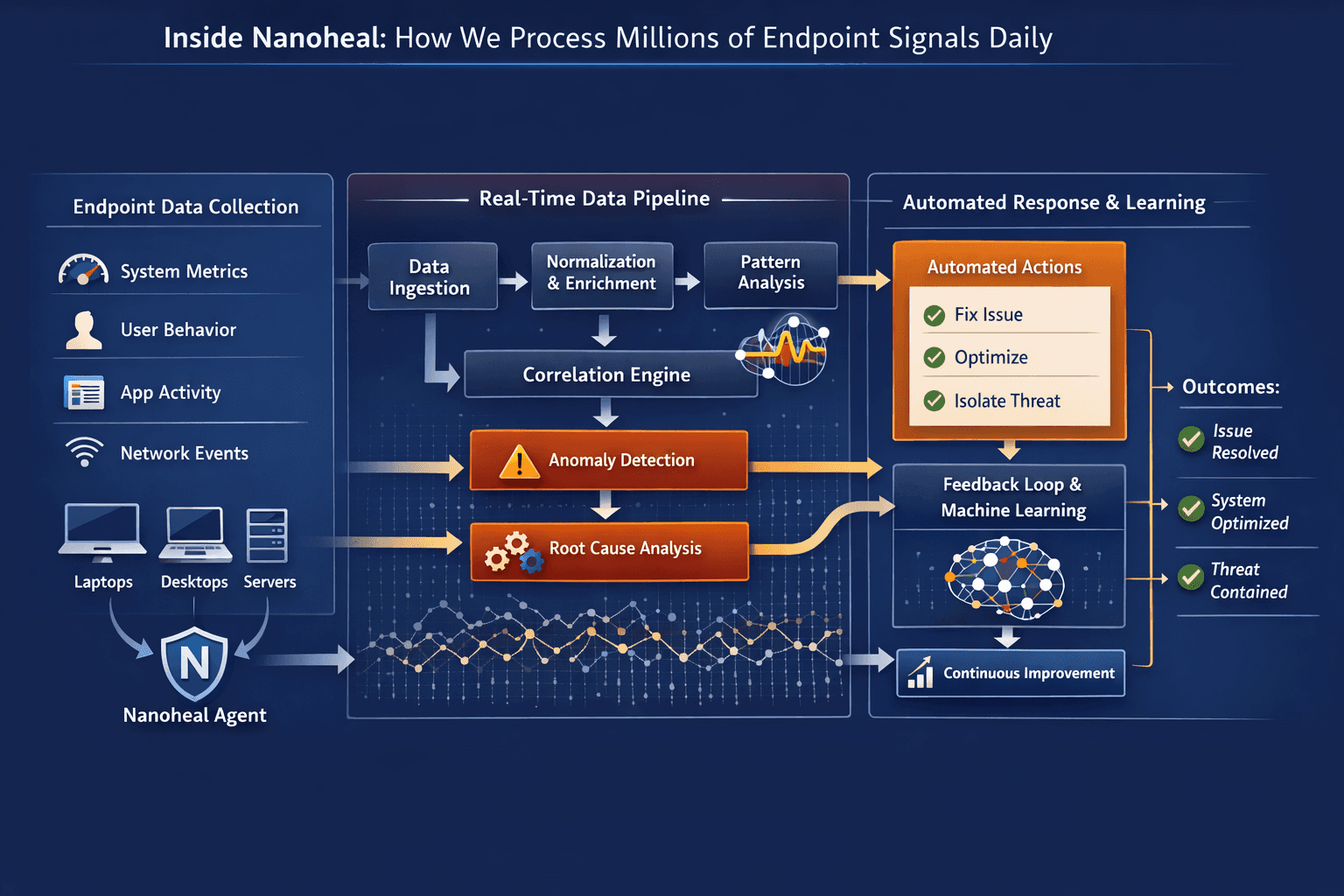
A system that truly operates intelligently should be able to:
Understand normal behavior at a granular level
Detect meaningful deviations, not just statistical anomalies
Identify probable root causes based on context
Trigger corrective actions automatically
Learn from outcomes to improve future decisions
This is a closed loop.
Detection without action is an open loop.
And open loops don’t scale.
Why Endpoints Are the Hardest Problem
AIOps has been more successful in infrastructure and application monitoring.
Endpoints are different.
They are:
Highly variable
User-dependent
Context-driven
Constantly changing
Two devices with identical configurations can behave very differently based on usage patterns.
This makes static rules ineffective and simplistic models unreliable.
Which is why many platforms stop at visibility.
It’s easier.
The Gap Between Promise and Practice
In most environments today, AIOps looks like:
Better dashboards
Fewer alerts (sometimes)
Faster identification of issues
But the resolution process remains largely manual.
That creates a mismatch between expectation and reality.
Organizations invest in AIOps expecting efficiency gains.
What they often get is improved awareness.
Useful, but not enough.
Where Nanoheal Fits In
Nanoheal approaches AIOps from a different angle.
Not as an analytics layer, but as an execution system.
It focuses on closing the loop:
Continuously analyzing endpoint behavior across system, application, and user layers
Identifying deviations that actually impact performance and experience
Determining likely root causes using contextual patterns
Triggering corrective actions automatically
Learning from each intervention to improve accuracy over time
The emphasis is not on showing more information.
It’s on reducing the need to act on that information manually.
A More Honest Definition
If we strip away the marketing, AIOps should be judged by a simple question.
Does it reduce the amount of work humans need to do?
Not in theory. In practice.
Are fewer tickets being created?
Are recurring issues being eliminated?
Is manual intervention decreasing over time?
If the answer is no, then it’s not really AIOps.
It’s enhanced monitoring.
Final Thought
The industry doesn’t need more intelligence in dashboards.
It needs intelligence in execution.
The real value of AIOps is not in helping teams understand problems faster.
It’s in making sure those problems never require attention in the first place.
That’s the difference between incremental improvement and actual transformation.