Back to blog
From IT Support to IT Autopilot: The Next Evolution of Enterprise IT
In
IT Service & Support
by
Divya CH
Enterprise IT has gone through several evolutions.
Each one improved efficiency. None of them fundamentally changed the model.
At its core, IT has remained reactive.
Something breaks.
Someone fixes it.
The system moves on.
What’s changing now is not just the tools, but the expectation.
Systems are no longer expected to be managed.
They’re expected to manage themselves.
The Four Phases of IT Operations
If you look at how IT has evolved, there’s a clear progression.
1. Manual IT
Everything was hands-on.
Issues were discovered by users.
Fixes depended entirely on individual expertise.
Knowledge lived in people, not systems.
It worked at small scale. It didn’t scale beyond that.
2. Structured IT (ITSM Era)
Processes were introduced.
Tickets.
SLAs.
Escalation paths.
This brought consistency and accountability.
But it didn’t reduce the volume of work.
It just organized it.
3. Observable IT
The focus shifted to visibility.
Better monitoring.
Real-time alerts.
Deeper analytics.
Teams could now see what was happening across systems.
This was a major step forward.
But again, it didn’t eliminate the need for action.
It just improved awareness.
4. Autonomous IT
This is where things start to change fundamentally.
The goal is no longer to detect and respond faster.
The goal is to reduce the need for response altogether.
Systems that:
Detect issues early
Diagnose root causes
Take corrective action
Learn from outcomes
All without waiting for human intervention.
This is what IT autopilot looks like.
Why the Old Model Is Breaking
The traditional support model is reaching its limits.
Scale
Organizations are managing thousands, sometimes tens of thousands of endpoints.
Manual intervention doesn’t scale linearly.
It breaks under volume.
Complexity
Environments are more dynamic than ever.
Remote work.
Multiple applications.
Constant updates.
Static rules and playbooks can’t keep up.
Expectations
Users expect systems to just work.
They don’t think in terms of tickets or SLAs.
They compare workplace technology to consumer experiences.
Instant. Reliable. Invisible.
The Shift from Effort to Outcome
For years, IT has optimized effort.
Faster resolution times.
Better ticket handling.
Improved support processes.
Autonomous IT optimizes outcomes.
Fewer issues.
Less disruption.
Minimal need for intervention.
It’s a subtle shift, but it changes everything.
What Autopilot Actually Means
Autopilot doesn’t mean removing humans from IT.
It means removing humans from repetitive, predictable work.
Engineers still:
Design systems
Define policies
Handle complex edge cases
But they don’t spend time on issues that the system already understands.
The system handles those on its own.
The Role of Continuous Learning
Autonomous systems are not static.
They improve over time.
Each issue handled adds to system knowledge
Patterns become clearer with scale
Responses become more precise
This creates a compounding effect.
The system doesn’t just operate. It evolves.
Where Nanoheal Fits In
Nanoheal is built around this shift.
Not as a monitoring tool. Not as a ticketing layer.
As an execution system designed for autonomy.
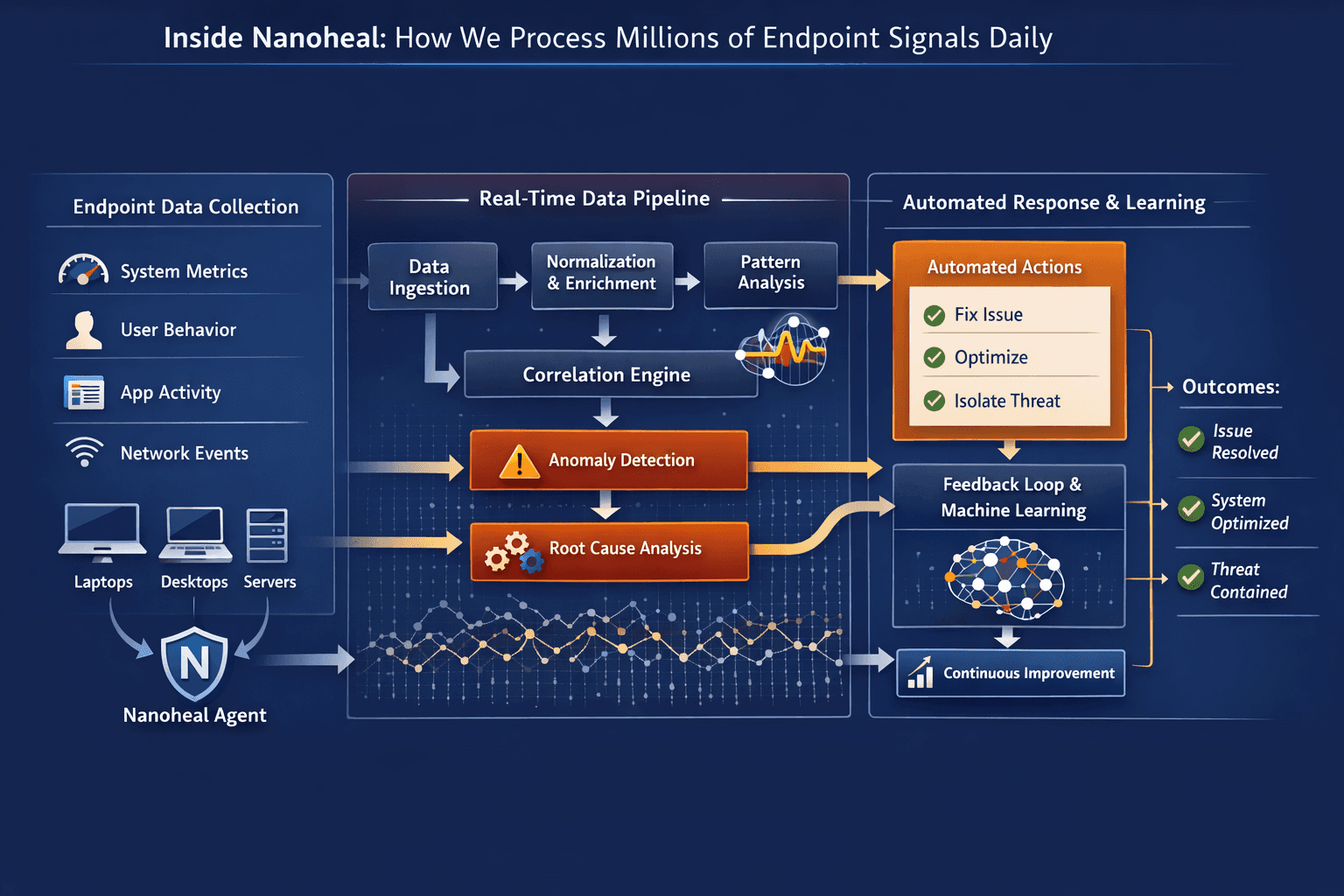
It continuously:
Observes endpoint behavior across system, application, and user layers
Identifies patterns that indicate emerging issues
Determines the most effective corrective actions
Executes those actions without waiting
Learns from outcomes to refine future responses
The goal is not to assist IT teams.
It’s to reduce the amount of work they need to do.
The Organizational Impact
Moving toward autopilot changes more than operations.
It changes how teams work.
Less time spent on repetitive support
More time on strategic initiatives
Reduced dependency on headcount growth
Improved consistency across environments
It also changes perception.
IT shifts from being a support function to a reliability engine.
Final Thought
Every previous phase of IT made things more manageable.
Autonomous IT makes things fundamentally different.
The question is no longer how to handle more tickets.
It’s how to operate in a way where most tickets never exist.
That’s the direction the industry is moving in.
The only real question is how quickly organizations get there.