Most organizations don’t think of device performance as a business problem.
It’s seen as an IT issue. A support function. Something that gets handled when a ticket is raised.
But step back for a moment.
Every slow device, every frozen application, every dropped VPN connection is not just an inconvenience. It is lost time, broken focus, and accumulated frustration.
And at scale, that adds up to something far more serious than “a few tickets.”
Productivity Loss Doesn’t Show Up in Reports
When a system goes down, it gets attention.
When an employee loses 10 minutes because their laptop is slow, it doesn’t.
That’s the blind spot.
These micro-frictions happen daily:
Applications taking too long to open
Systems slowing down after a few hours of usage
Background processes consuming resources
Intermittent network instability
Individually, they seem trivial.
Collectively, they create a continuous drag on productivity.
Multiply that across hundreds or thousands of employees, and you’re looking at a silent but significant cost center.
The Compounding Effect of Friction
The real impact isn’t just time lost. It’s how often it happens.
An employee who loses:
10 minutes a day
5 days a week
48 weeks a year
That’s 40 hours annually.
One full work week gone.
Now multiply that across your organization.
This is not an edge case. This is the baseline in most environments.
It’s Not Just About Speed
Digital Employee Experience (DEX) is often misunderstood as device performance alone.
It’s broader than that.
It includes:
Application reliability
System responsiveness over time
Stability under real-world usage
Consistency across locations and networks
Absence of recurring issues
A device that works well in the morning but slows down by afternoon is not a healthy device.
A system that requires frequent restarts to “stay usable” is not stable.
These are not failures. They are normalized inefficiencies.
Why IT Misses This
Most IT systems are designed to detect failures, not friction.
They look for:
Crashes
Errors
Threshold breaches
But many DEX issues don’t trigger alerts.
They operate below thresholds.
They degrade gradually.
They depend on user behavior and context.
Which means they rarely show up unless someone complains.
And by then, the experience has already been poor for a while.
The Business Impact No One Owns
This is where things get interesting.
IT owns systems.
HR owns employee experience.
Finance tracks productivity at a high level.
But no one owns the intersection.
So the cost of poor digital experience sits in a gap:
Not visible enough for finance
Not structured enough for HR
Not critical enough for traditional IT monitoring
And yet, it affects all three.
Moving from Reactive Support to Experience Management
Fixing DEX is not about faster ticket resolution.
It’s about preventing the need for tickets in the first place.
That requires a different approach:
Continuous monitoring of real user experience, not just system metrics
Detecting patterns of degradation before they become visible issues
Understanding how device behavior impacts productivity
Automatically correcting issues without waiting for escalation
This is where endpoint intelligence becomes critical.
Because the problem lives at the device level, in real usage conditions.
Where Nanoheal Fits In
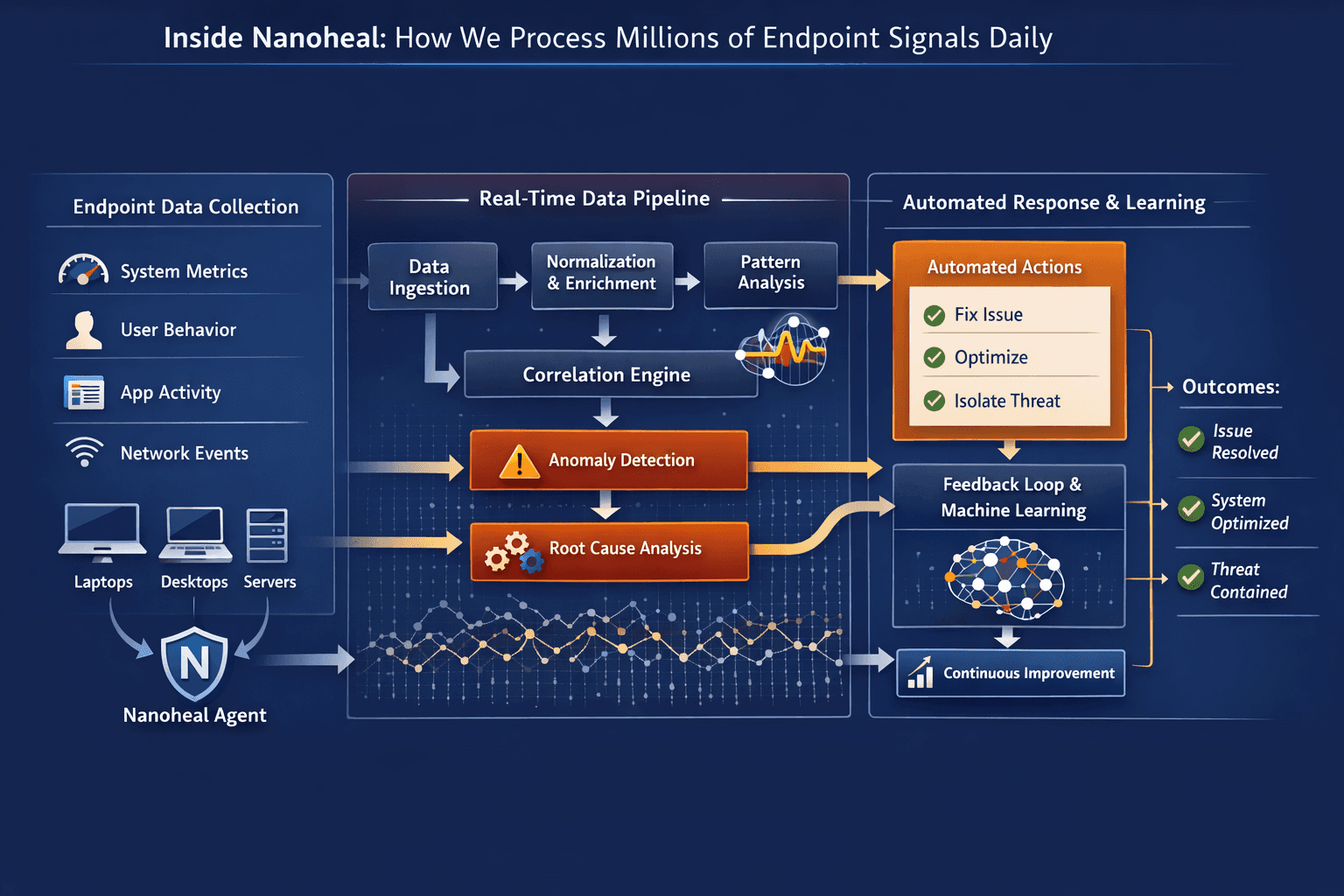
Nanoheal approaches DEX from the ground up.
Not as a reporting layer, but as a control system.
It continuously analyzes endpoint behavior to identify:
Performance degradation patterns
Resource anomalies
Application-level issues
Early signals of instability
More importantly, it doesn’t stop at detection.
It acts.
Cleaning up resource bottlenecks
Fixing configuration drift
Resolving recurring issues automatically
Restoring performance before users are impacted
The goal is simple.
A system that works the way users expect it to, without requiring intervention.
Rethinking the Metric
If you want to understand your true digital experience, don’t ask:
“How many tickets did we close?”
Ask:
How many issues never reached the user?
How consistent is device performance throughout the day?
How often do users experience slowdowns that go unreported?
These are harder to measure.
But they are far closer to reality.
Final Thought
Poor digital experience rarely shows up as a crisis.
It shows up as a pattern.
A few minutes lost here. A delay there. A recurring frustration that becomes part of the workday.
Over time, that becomes the norm.
And that’s the real problem.
Because once inefficiency feels normal, it stops being questioned.
The organizations that get ahead of this are not the ones with better support.
They’re the ones where things simply work.
Consistently. Quietly. In the background.