Back to blog
Why Endpoint Issues Spike When Teams Are Away (The Holiday Slowdown Myth!)
In
IT Service & Support
by
Divya CH

There’s a common assumption in most organizations.
When people are away, systems are under less pressure.
Fewer users. Fewer operations. Fewer problems.
In theory, the holiday period should be one of the calmest times for IT.
In practice, it rarely is.
For many teams, this is when issues quietly accumulate.
Not dramatic outages. Not major incidents.
A steady buildup of small problems that surface all at once when everyone returns.
What Actually Changes During Holidays
The environment doesn’t just “slow down.” It shifts.
Usage patterns become unpredictable.
Some devices are idle for days
Others are used intermittently, often remotely
Systems may miss regular update cycles
Networks vary between office, home, and travel setups
These aren’t failures. They’re deviations from normal behavior.
And systems that rely on consistency tend to struggle with that.
Idle Systems Are Not Stable Systems
There’s an assumption that if a device isn’t being used, it remains in a good state.
That’s rarely true.
During periods of inactivity:
Updates may be delayed or partially applied
Scheduled maintenance tasks may not complete
Background processes may not reset cleanly
Cached data continues to accumulate
When the system is used again, these latent issues surface.
What looked like a quiet period turns into a burst of problems.
The Return-to-Work Effect
The first week after a holiday often tells the real story.
Devices come back online.
Users resume full workloads.
Systems are pushed back to normal operating levels.
And suddenly:
Systems feel slower than usual
Applications behave inconsistently
Connectivity issues appear
Updates start failing
From the user’s perspective, it feels like everything broke at once.
In reality, it didn’t.
The issues were already there. They just weren’t visible yet.
Remote Work Amplifies the Problem
Holiday periods often mean more remote usage.
Different networks. Different devices. Less controlled environments.
This introduces variability:
Unstable connections
Inconsistent VPN behavior
Greater exposure to configuration drift
Delayed synchronization with enterprise systems
All of this increases the likelihood of issues that don’t show up immediately.
Why IT Teams Get Caught Off Guard
The challenge is not that these issues are unknown.
It’s that they don’t trigger traditional signals.
No major outages
No immediate spikes in alerts
No obvious failures during the downtime
So everything appears normal.
Until usage returns to normal.
At that point, IT is suddenly dealing with a surge of tickets that feel unrelated but share a common cause.
A Different Way to Think About “Quiet Periods”
Instead of treating holidays as low-activity periods, they should be seen as maintenance opportunities.
Time when systems can be:
Brought back to a clean baseline
Checked for pending updates and inconsistencies
Monitored for silent degradation
Stabilized before normal usage resumes
This requires shifting from reactive monitoring to continuous maintenance.
Where Nanoheal Fits In
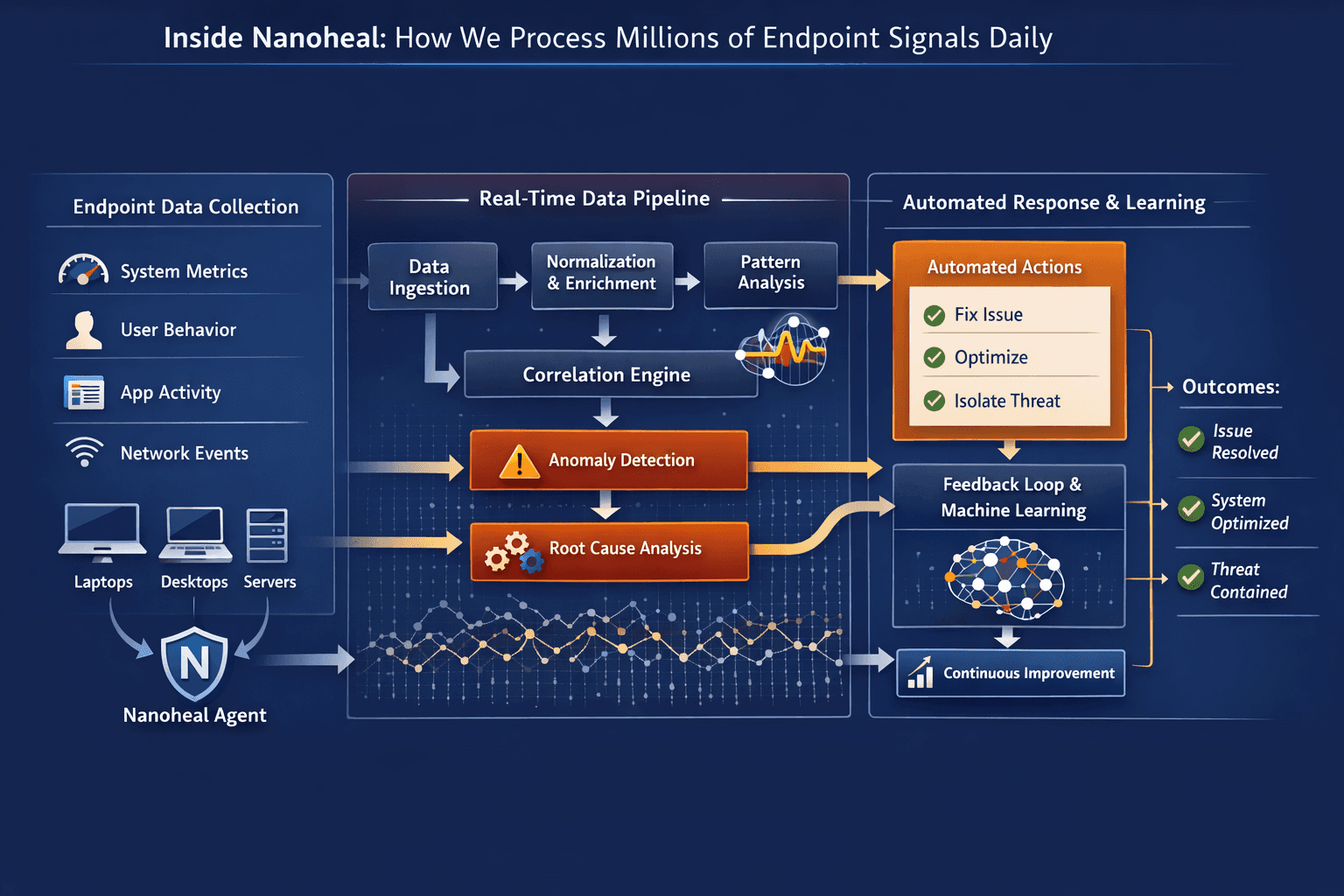
Nanoheal treats endpoint health as something that needs to be maintained continuously, not just when issues are reported.
During periods of low or irregular usage, it:
Detects systems drifting away from optimal states
Identifies incomplete updates and pending changes
Cleans up accumulated inefficiencies
Ensures devices return to a stable baseline
All of this happens without waiting for user-triggered issues.
So when activity resumes, systems are ready.
Not recovering.
The Real Opportunity
Holiday periods don’t reduce risk.
They change how risk shows up.
Organizations that treat this time as “quiet” often end up dealing with the consequences later.
Those that treat it as a window for stabilization start the new cycle in a much stronger position.
Final Thought
Not all problems happen when systems are under pressure.
Some build up when no one is paying attention.
The difference is when you choose to deal with them.
Before users notice.
Or after everything feels broken at once.