For decades, enterprise IT has operated on a simple model:
something breaks → a ticket is raised → someone fixes it.
It worked, when systems were simpler, environments were smaller, and expectations were lower.
That world no longer exists.
Today, a single enterprise manages thousands of endpoints, dozens of applications, hybrid work environments, and an always-on workforce. And yet, most IT teams are still running on a model designed for a different era.
The result?
A system that is permanently reactive, increasingly overwhelmed, and fundamentally unsustainable.
The Problem Isn’t Scale. It’s the Model.
Most IT leaders assume the challenge is scale - more devices, more users, more complexity.
But scale is only exposing a deeper flaw:
the dependency on human-triggered intervention.
Every ticket represents:
A failure that was not prevented
A user whose productivity was already impacted
An IT team reacting after the fact
Even with modern tools, monitoring, alerts, dashboards, the core model hasn’t changed. We’ve simply made reaction more efficient.
And that’s the trap.
Observability Gave Us Vision,But Not Control
Over the last decade, enterprises invested heavily in observability.
Dashboards became richer. Alerts became smarter. Data became abundant.
But here’s the uncomfortable truth:
Visibility does not equal resolution.
Knowing that:
A device is slowing down
A patch has failed
An application is crashing
…doesn’t fix the issue.
It still requires:
A ticket
A diagnosis
A manual or scripted response
In many cases, by the time action is taken, the user has already adapted by restarting, abandoning the task, or worse, losing trust in IT.
The Shift: From Detection to Autonomous Resolution
What’s emerging now is not an incremental improvement, but a fundamental shift:
Systems that don’t just detect issues, but resolve them autonomously.
This is the foundation of self-healing endpoints.
Instead of:
detect → alert → ticket → fix
The model becomes:
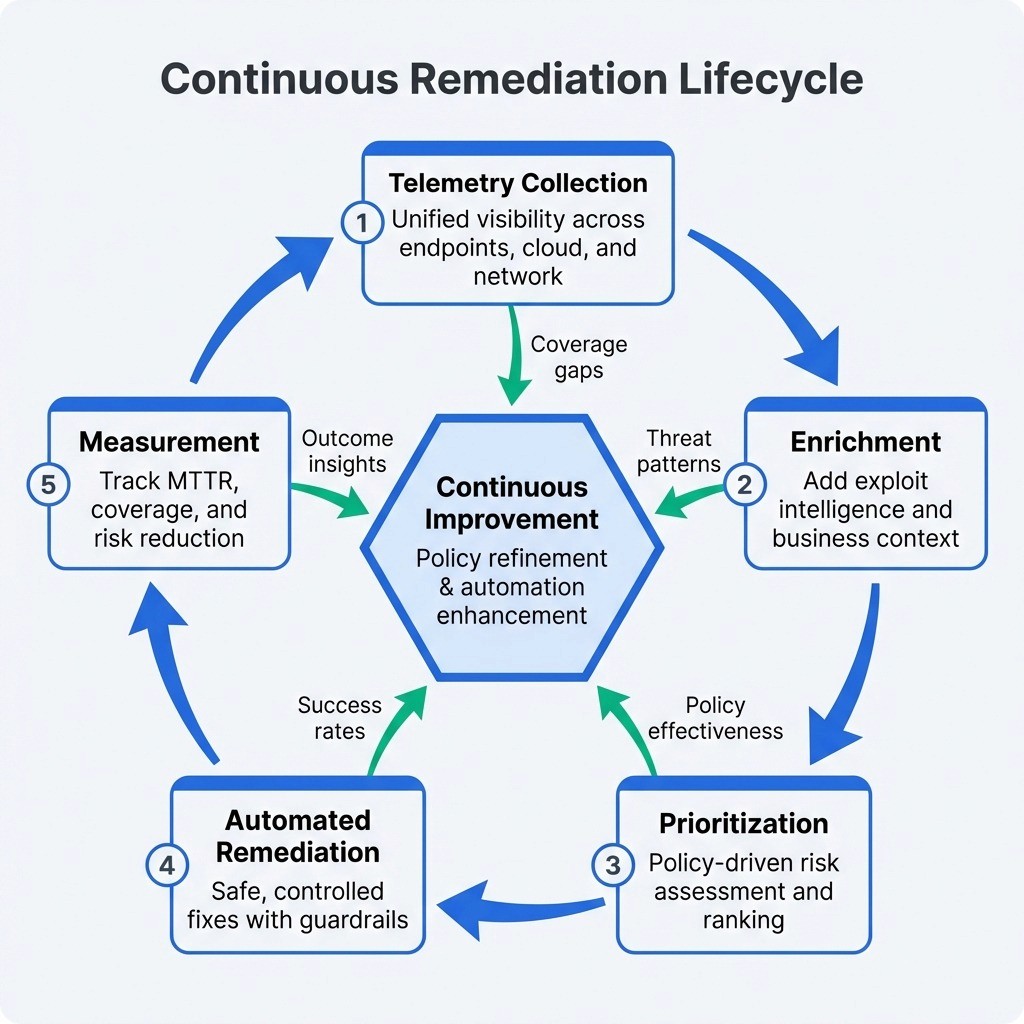
detect → decide → resolve
In real time. Without human intervention.
What “Self-Healing” Actually Means (Beyond the Buzzword)
Self-healing is often misunderstood as scripted automation.
It’s not.
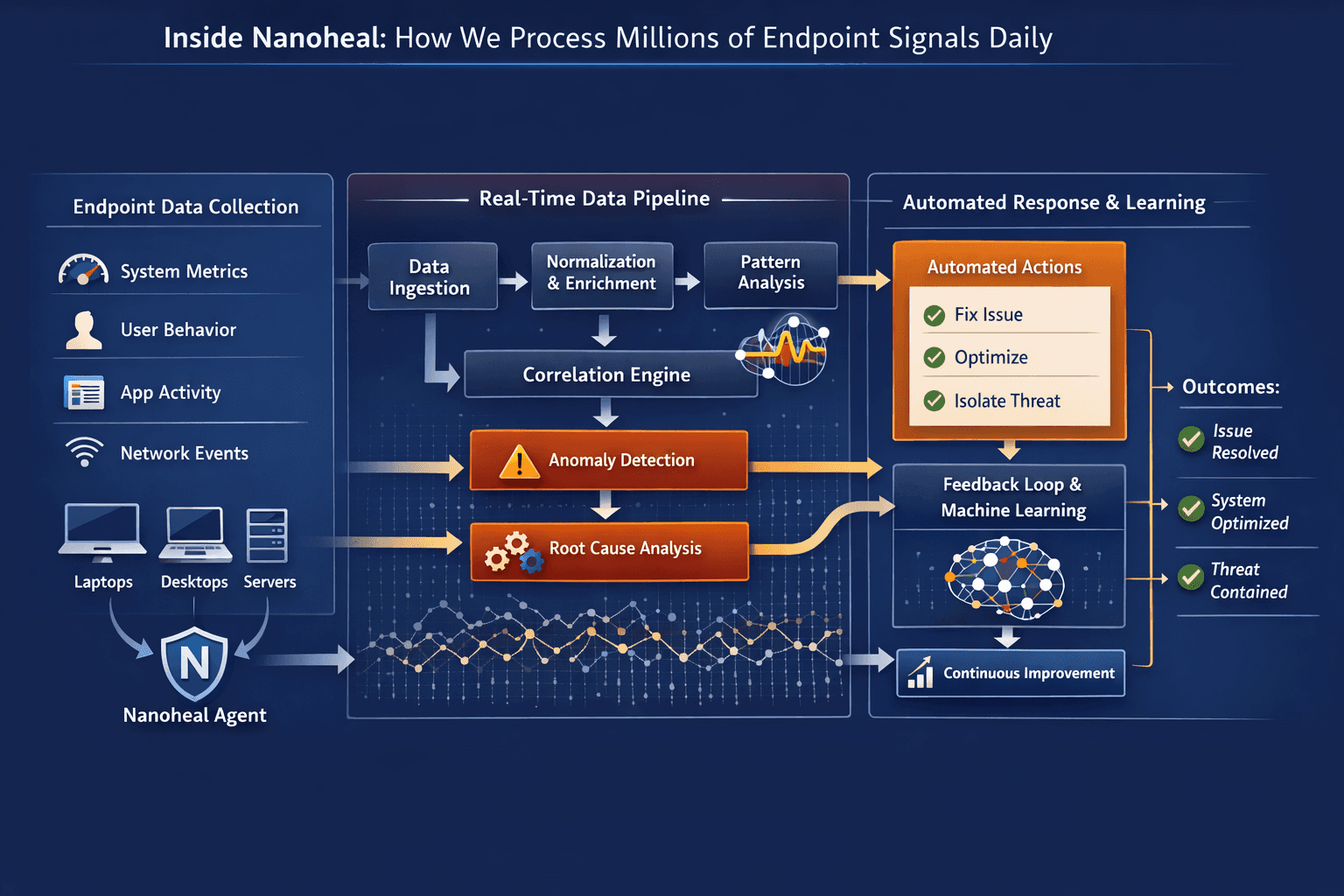
True self-healing systems operate on three layers:
1. Continuous Device Intelligence
Not just metrics like CPU or RAM but behavioral patterns:
Performance degradation trends
Application anomalies
User interaction signals
2. Contextual Decisioning
Understanding why something is happening:
Is this a one-off spike or a recurring issue?
Is it user-specific, app-specific, or system-wide?
3. Autonomous Remediation
Executing the right action instantly:
Clearing resource bottlenecks
Fixing failed services
Reconfiguring broken dependencies
Preventing recurrence
At Nanoheal, this is where things get interesting.
Because the real value isn’t just in detecting anomalies, it’s in closing the loop automatically.
The Silent Impact: Productivity Without Friction
The biggest benefit of self-healing systems isn’t visible in dashboards.
It’s visible in what doesn’t happen:
No slowdown complaints
No recurring tickets
No “IT is slow” perception
Users don’t notice great IT.
They notice broken IT.
Self-healing flips that equation by removing friction before it surfaces.
Why This Matters Now
Three forces are accelerating this shift:
1. Hybrid Work is Permanent
Devices are no longer within controlled networks. Issues must be resolved remotely, instantly.
2. IT Talent is Limited
Scaling teams linearly with endpoints is no longer viable.
3. Expectations Have Changed
Users expect systems to “just work”—like consumer tech.
Reactive IT cannot meet these expectations.
Autonomous IT can.
From Support Function to Autonomous System
The future of IT is not more tickets.
It’s fewer.
Not faster resolution times.
But fewer issues reaching users at all.
This is the transition:
From IT Support → to IT Autopilot
From manual intervention → to autonomous systems
And endpoints are where this transformation begins.
Where Nanoheal Fits In
Nanoheal was built around a simple belief:
IT systems should fix themselves before users are impacted.
By combining:
Deep endpoint intelligence
Real-time anomaly detection
Automated remediation workflows
Nanoheal moves IT from reactive firefighting to proactive, and increasingly autonomous, operations.
Not as a future vision—but as a present capability.
The Bottom Line
Reactive IT isn’t failing because teams aren’t working hard enough.
It’s failing because the model itself is outdated.
Self-healing systems are not a luxury anymore.
They are becoming the baseline.
The question isn’t whether enterprises will adopt this model.
It’s how long they can afford not to.