

What is DEX?
What DEX measures, and where measurement stops.
Digital employee experience (DEX) measures technology the way your people meet it: on every device, before anyone calls. Nanoheal scores it on a patented methodology.
Most friction is never reported. DEX measures it anyway.
A record built on reports sees only what people bother to raise. The rest stays invisible: the laptop that takes minutes to boot, the call that freezes every afternoon.
HappySignals research puts the productive time lost per IT incident at 3 hours 18 minutes, and finds that 13% of tickets cause 80% of lost productivity.
DEX measures endpoints, applications, the network and the employees themselves, so the slow boot every morning shows up before anyone files a ticket.
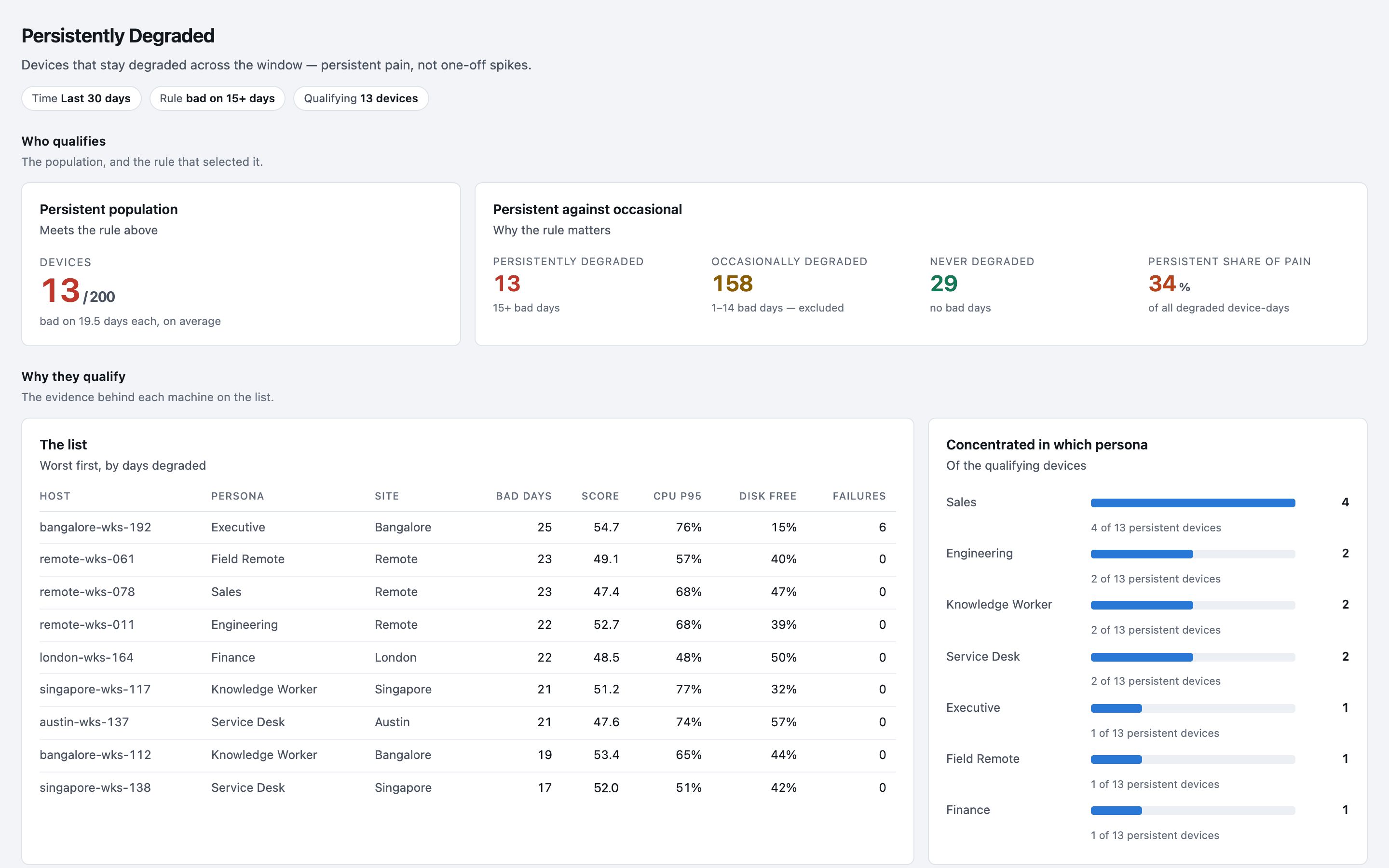
The listWorst first, by days degraded
| Host · persona | Bad days | Score |
|---|---|---|
| bangalore‑wks‑192 · Executive | 25 | 54.7 |
| remote‑wks‑061 · Field Remote | 23 | 49.1 |
| remote‑wks‑078 · Sales | 23 | 47.4 |
| remote‑wks‑011 · Engineering | 22 | 52.7 |
| london‑wks‑164 · Finance | 22 | 48.5 |
| singapore‑wks‑117 · Knowledge Worker | 21 | 51.2 |
| austin‑wks‑137 · Service Desk | 21 | 47.6 |
| bangalore‑wks‑112 · Knowledge Worker | 19 | 53.4 |
| singapore‑wks‑138 · Service Desk | 17 | 52.0 |
Five questions, and each one needs the answer before it.
Stop after the first and you have monitoring with a better chart. Stop after the fourth and you have a diagnosis nobody acts on.
- 01 · Measure
What is happening?
Performance, stability, application and network experience across the estate, scored on a method that holds still.
In NanohealA patented experience score (US 9,477,573).
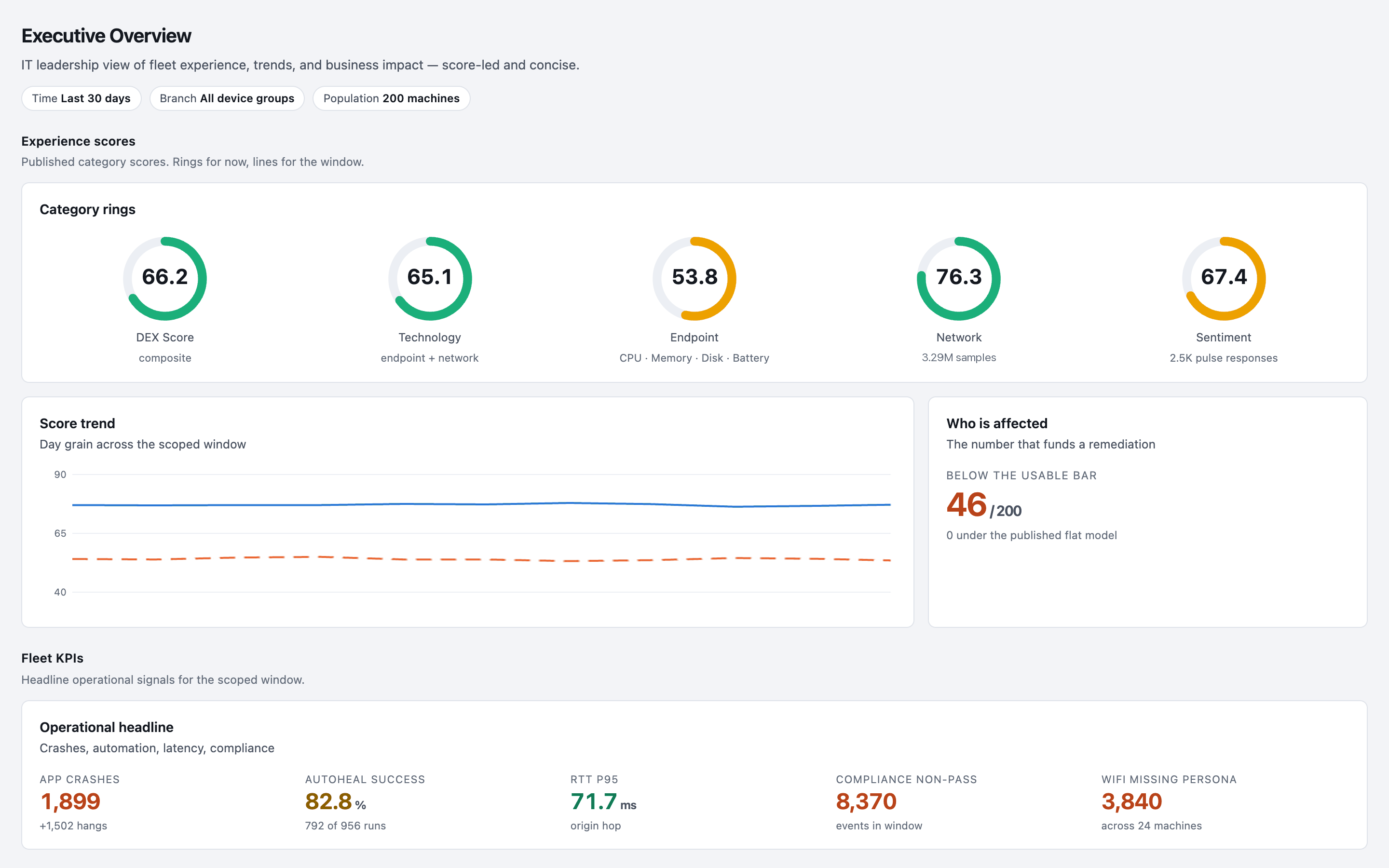
Haya analytics · Executive Overview - 02 · Forecast
What is likely to happen?
Disks that fill on a curve, memory pressure that builds over weeks, a capacity date you can see coming.
In NanohealForecasting, with a likely range and a date for when capacity runs out.
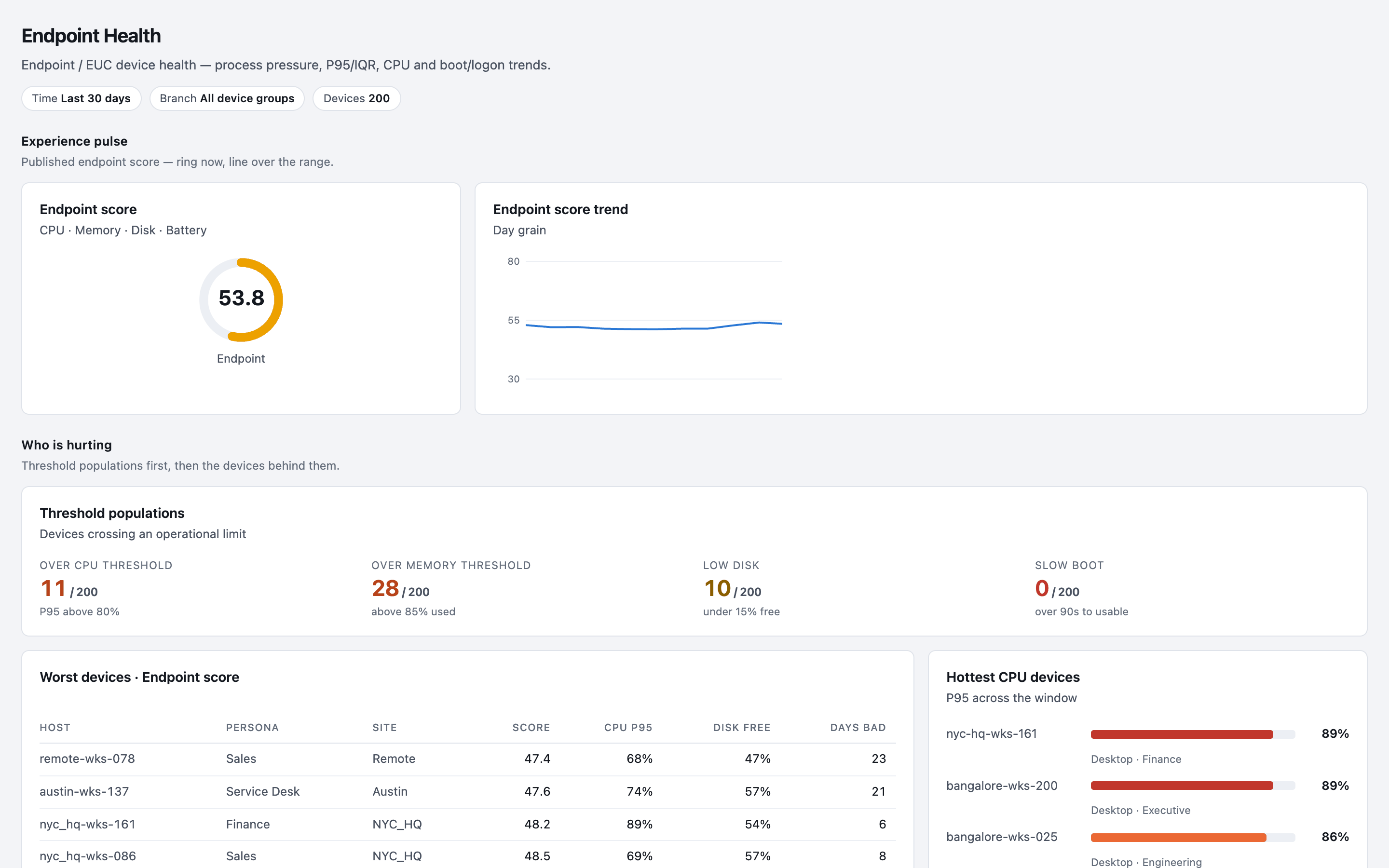
Haya analytics · Endpoint Health - 03 · Detect
What has changed?
Anomalies nobody wrote a rule for, surfaced before the call volume moves.
In NanohealAnomaly detection against each device’s, site’s or group’s own history.
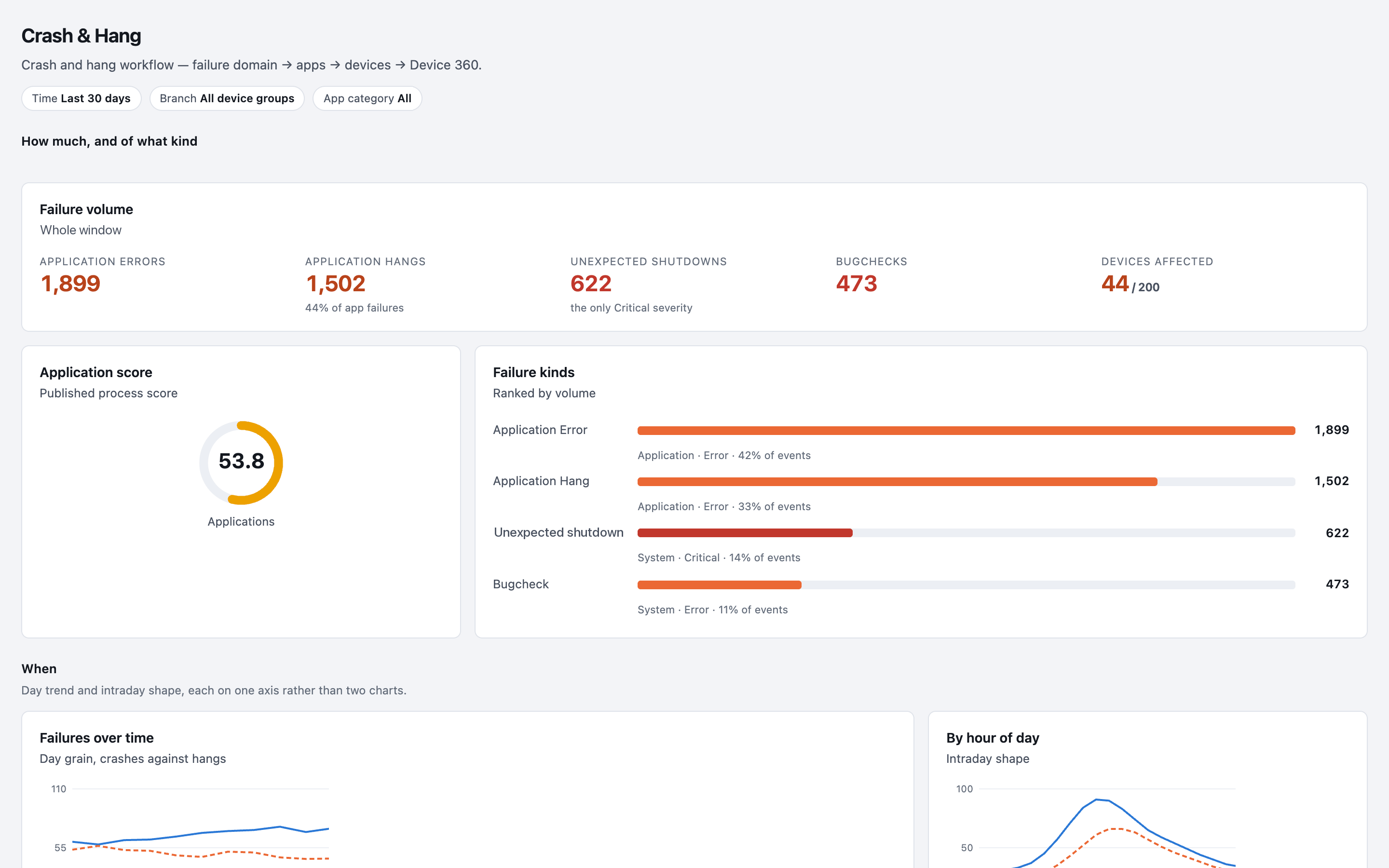
Haya analytics · Crash & Hang - 04 · Diagnose
Why is it happening?
The signal traced to where it started, so an engineer, or a validated capability, can act on it.
In NanohealRoot-cause ranking of which sites and device groups drove it.
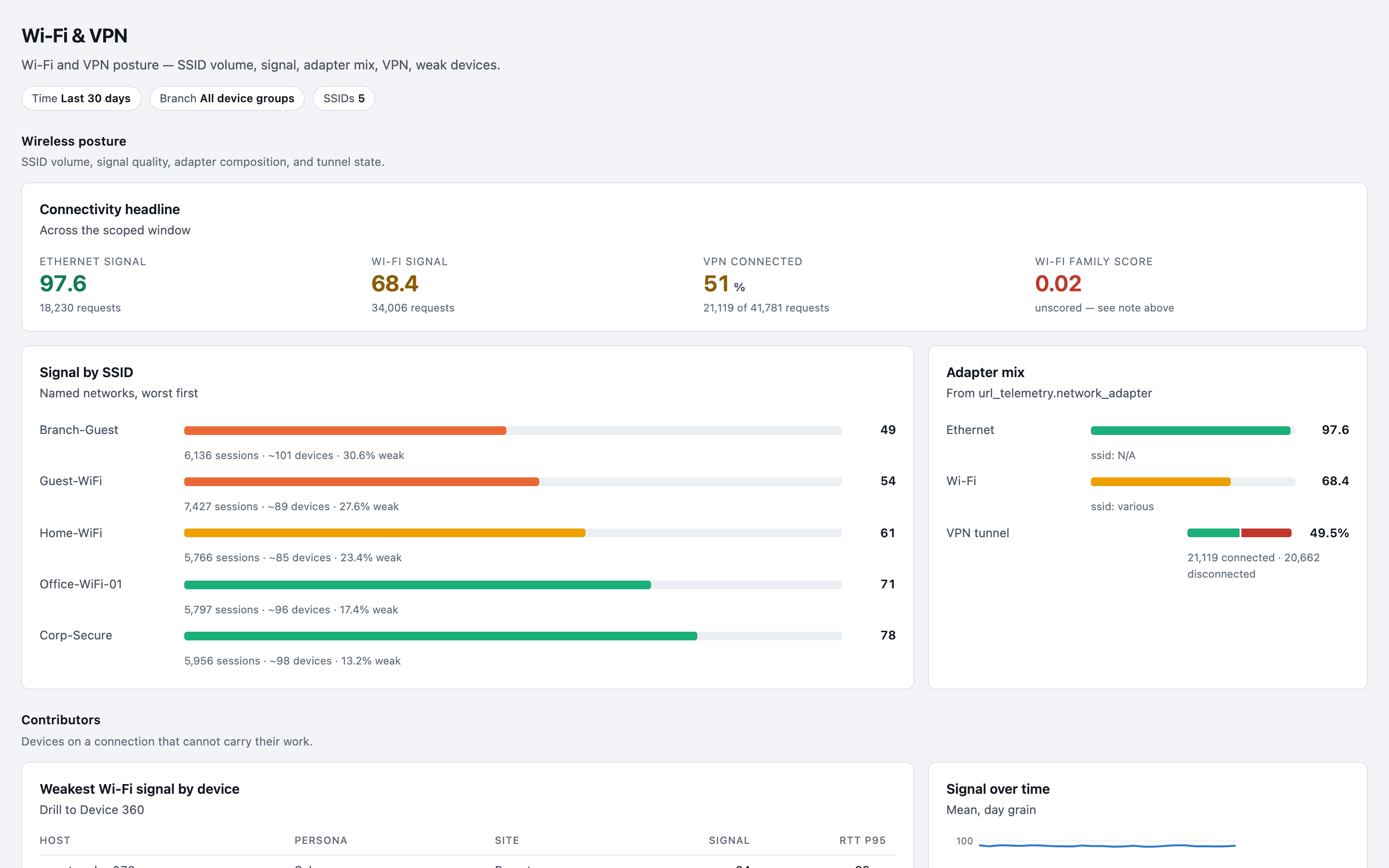
Haya analytics · Wi-Fi & VPN - 05 · Prove
Did the experience improve?
The same score, before and after the change, so improvement is measured rather than asserted.
In NanohealThe score before and after each fix.
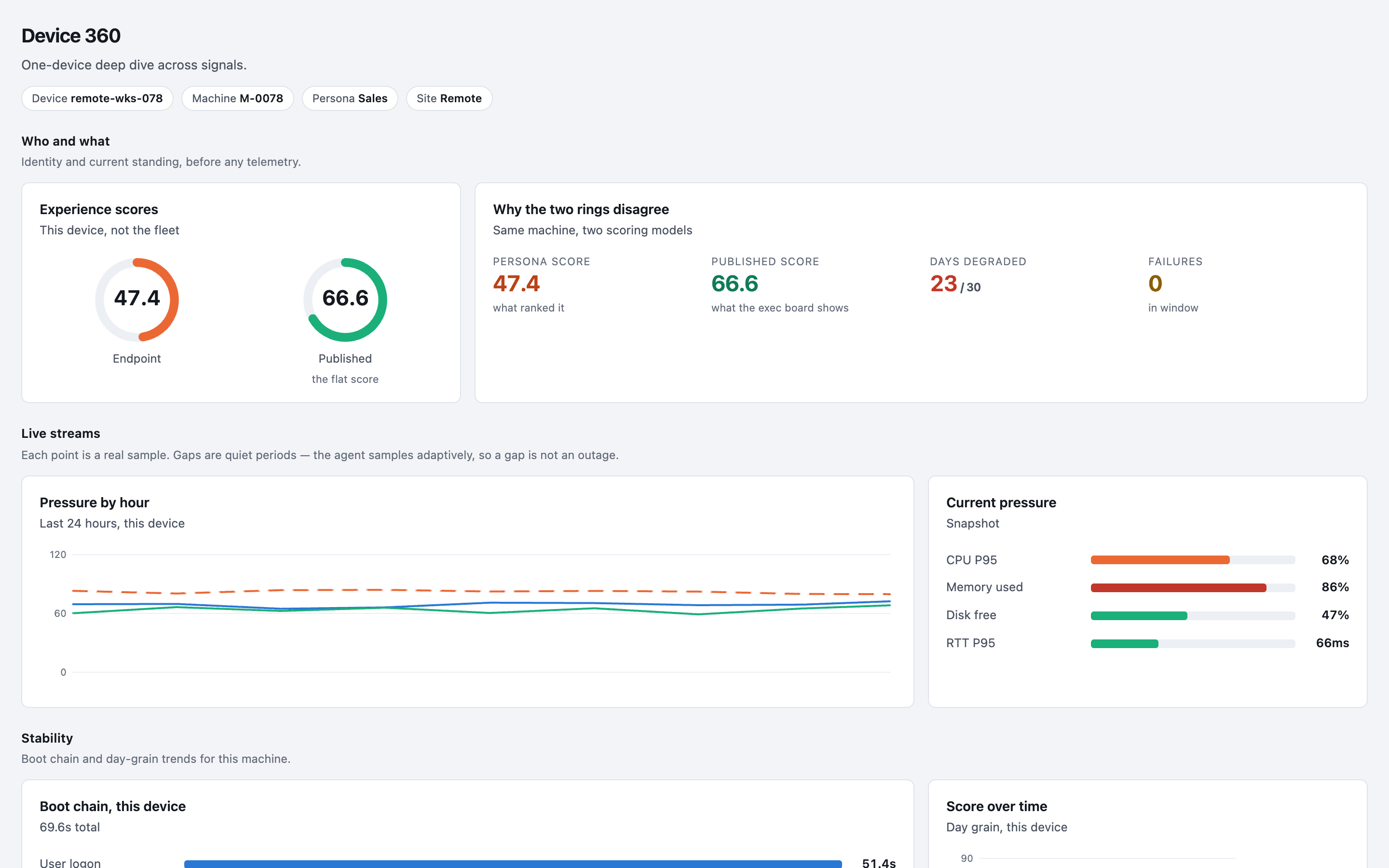
Haya analytics · Device 360
Forecasting and anomaly detection matter most where nobody wrote a rule: a change that behaves differently in production, or a slow regression that never crosses a threshold.
In Nanoheal this is the job of Haya, our AI and analytics. Haya finds the problem and shows the fix; a person approves what runs.
The endpoint is one domain of four.
A device can be healthy while the person using it has a bad day. DEX measures both, on the same score, so a regression in one domain is comparable with a regression in any other.
Devices
Boot and logon time, CPU, memory and disk pressure, battery health, crashes and hangs.
The most common source of friction, and the easiest to fix once it is seen.
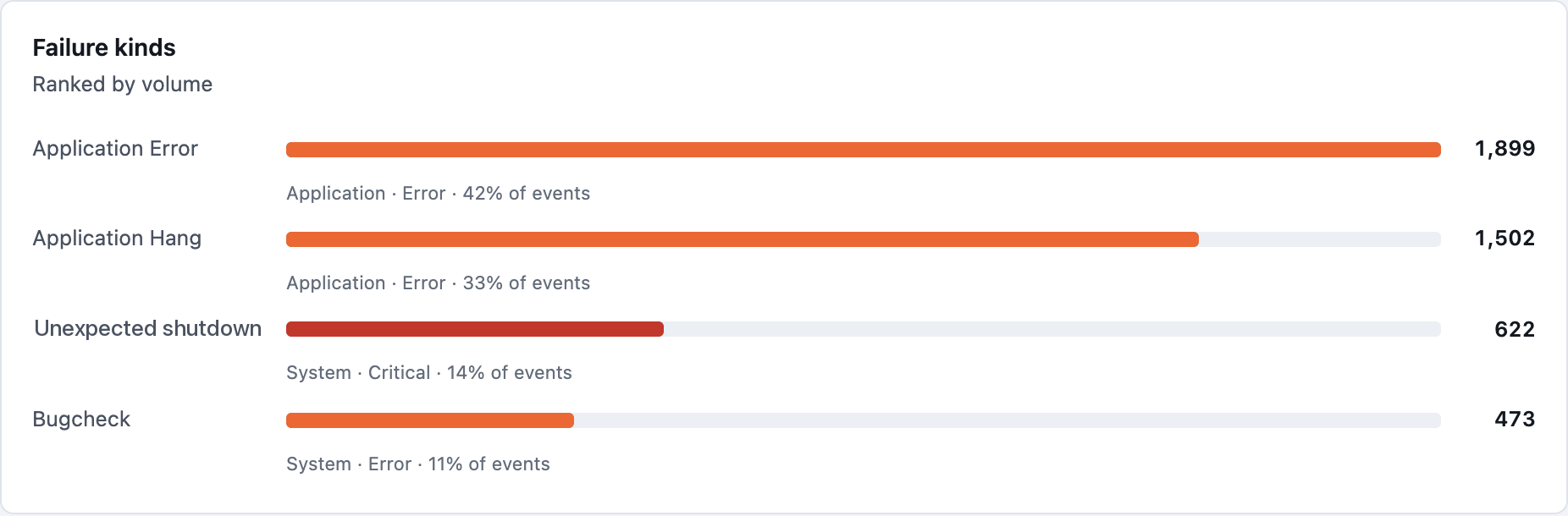
Applications
Launch and response times, crashes, hangs and failures in the applications people actually use.
Employees experience applications, not hardware. A healthy laptop running a failing client is still a bad day.
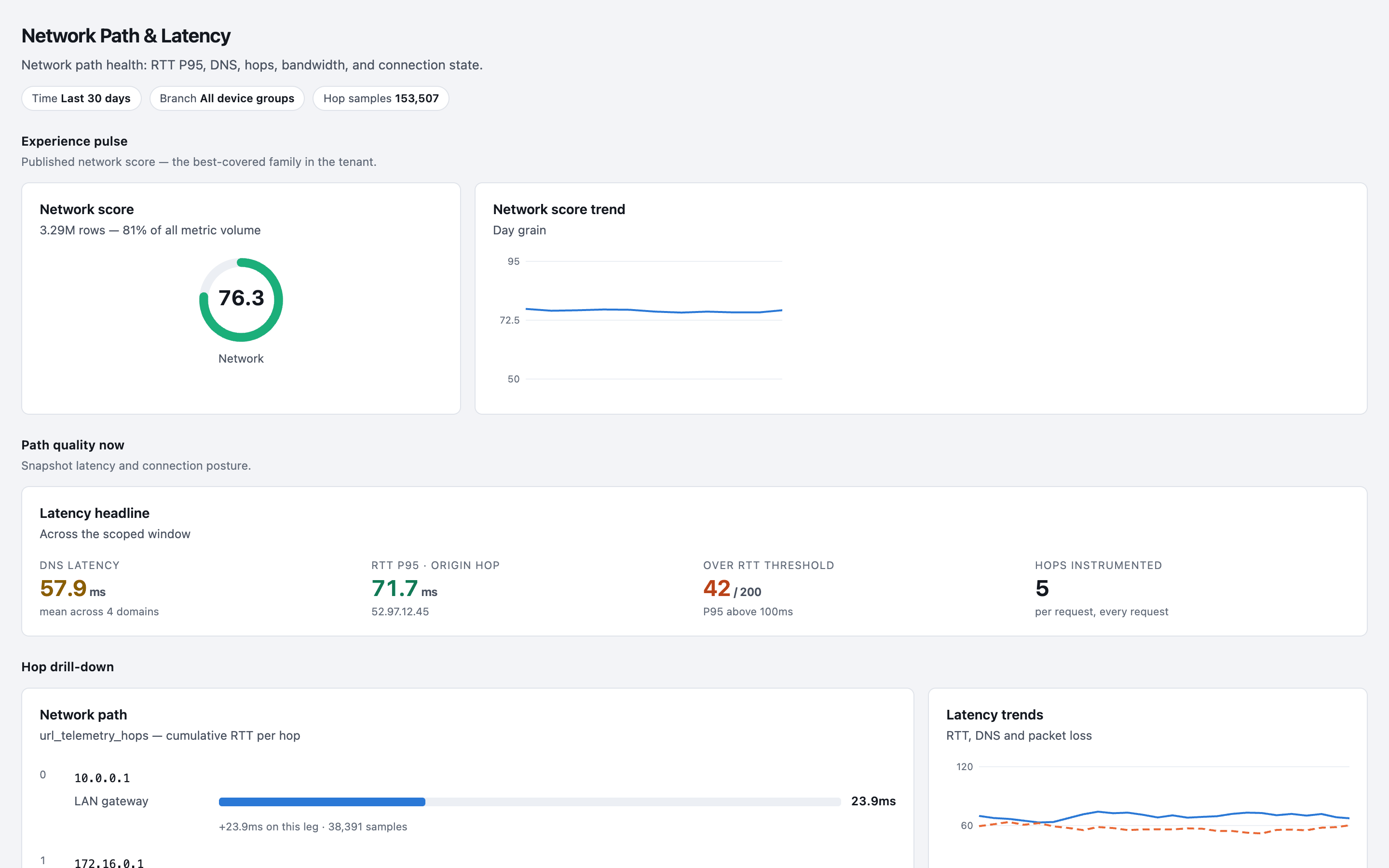
Network
Wi-Fi and VPN behaviour, latency to the services that matter, and call quality.
Hybrid work moved the network out of IT’s building. Experience has to be measured wherever people work.
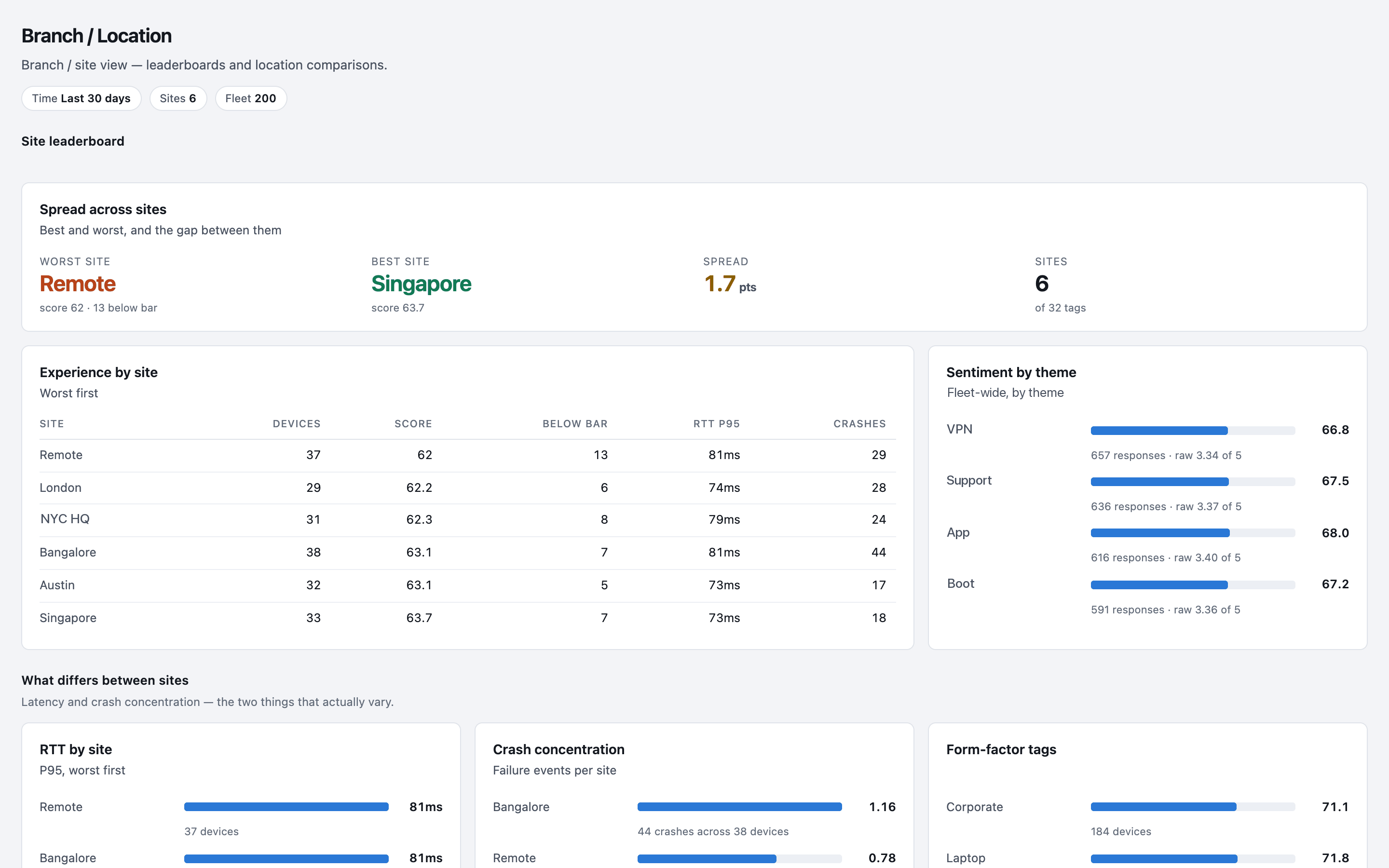
Sentiment
How employees say their technology is treating them, tied to the device and the moment.
Telemetry shows what happened. Sentiment shows whether anyone minded.
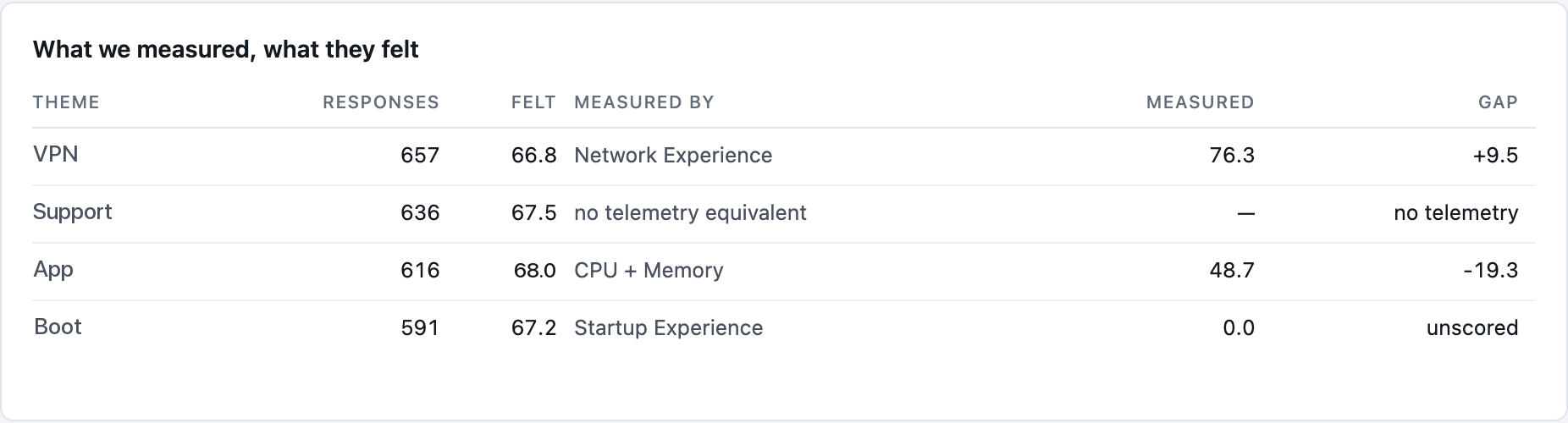
In Nanoheal, the agent collects boot time, CPU, memory, disk, battery, network, logon, application use and Windows events, and Haya charts sentiment and reported friction, scored alongside telemetry.
One number that holds still.
A DEX score rolls the four domains into one number a leadership team can read, set targets against and write into experience-level agreements (XLAs).
A score is only useful if the definition does not move. If the index is re-weighted between releases, nobody can say whether the number rose because the fleet improved or because the counting changed.
Nanoheal’s experience score is patented (US 9,477,573) and runs from 0 to 100, combining technology measurements with employee sentiment. Bands read good from 70, average from 40 and frustrating below that. Profiles are configurable per persona and versioned, so a gain measured this quarter means the same thing next quarter. How the score works.
The insight lands in a dashboard. Most fixes land in a queue.
DEX will tell you, reliably, that a known fault is back on hundreds of machines. A few have a scripted fix. Someone resolves the rest by hand, every time they return.
What closes the gap is Digital Experience Automation (DXA). The problem is the trigger, Haya works out what it means on this device, a tested fix runs there, and the same score shows whether it worked.
- Measure. Devices, applications, network and sentiment, on a patented score.
- Find. Anomalies, forecasts and root-cause ranking on the same data.
- Act. A tested fix runs on the device when the problem appears. What is DXA?
- Coexist. Nanoheal runs alongside your existing DEX tool, or replaces it.