

Ticket deflection & Autoheal
Resolved before the employee calls.
Deflection should mean the fault is gone, not that the employee gave up. Autoheal fixes the fault on the device, so there is nothing to call the desk about.
3h 18mof work an employee loses to each IT incident 1,200+fixes mapped to your top call drivers in week one Time lost per incident: HappySignals Global IT Experience Benchmark, 2026
Print Spooler terminated unexpectedly Resolved.
Ticket never raised. ✓ Fixed and verified on the device · Ticket avoided
Two ways to deflect a ticket.
What normally happens
The contact moves somewhere cheaper, and the fault stays.
A bot answers or a form gets filed, and the contact is recorded somewhere cheaper. The employee still lost the time, and the device still has the fault tomorrow.
- 00.00 Spooler stops. Nothing tells anyone.
- 08.40 Printing fails. The employee notices.
- 12.15 Searches the portal in their own words.
- 14.02 Finds an article written for a technician.
- 21.30 Gives up.
- 22.05 Calls the desk. A ticket is raised.
What Nanoheal does
The device fixes the fault and checks it worked.
The device reports the spooler error, Nanoheal matches it to a known fix and the device corrects it, then verifies the result. The employee prints again without calling anyone, and the same fix now covers every other device with that fault.
- 00.00 OS emits Event 7031: Print Spooler terminated unexpectedly
- 00.03 Nanoheal picks it up the moment the OS reports it
- 00.41 Matched to a fix in the library: spooler-corrupt-queue
- 00.88 Steps run: stop service · purge queue · repair key · restart
- 01.62 Printing works. No ticket raised, and the fix now covers every device.
See it on your own tickets.
Send us your ticket export. We show you the coverage, then resolve the biggest drivers live.
We report deflection as two separate numbers.
Tickets resolved with no human contact, and tickets avoided across the three ways a fix runs: on its own (Autoheal), offered to the employee on the device (Self-service) or run by the desk (Assisted IT). Both are counted per automation, so you can see which fix moved which number.
- Resolved with no human contact
- Autoheal fixed it on the device. No ticket was opened, nobody was contacted and the employee lost no time.
- Avoided overall
- Adds the fixes the employee accepted on the device (Self-service) and the ones the desk ran once, without a back-and-forth (Assisted IT).
We keep going past the top ten drivers.
Scripted automation usually stops at the top ten: the eleventh script costs as much as the first and returns a fraction. We keep going down the list.

Covered by a fix Not yet covered Long tail
- Top ten drivers
Large and well understood. Scripted automation usually covers them. Nanoheal covers most of them from the 1,200+ fixes in the automation library on day one, and the automation builder covers the rest.
- The long tail
Small each, large together. Rarely worth a script’s build and upkeep.
- With Nanoheal
Each tail driver is built in the visual automation builder, tested once and reused across your fleet.
Your desk is open eight hours a day. Devices report faults around the clock.
Now · where you are
- Service desk only. Anything reported after 5 pm or before 9 am waits for the desk to open. The evening waits through the night.
- With Nanoheal. The same symptoms, resolved when they’re reported, at any hour.
9 of 13 symptoms arrived while the desk was closed · longest wait 15h 24m
Your desk gets the tickets that need a person.
In Assisted IT, each ticket opens with the likely cause, how many devices share it and the approved fix, run on one device or the whole group through real-time remote execution. The desk doesn’t shrink; the repeat work leaves it.
A ticket that needs a person
The desk’s own board · what is still on fire
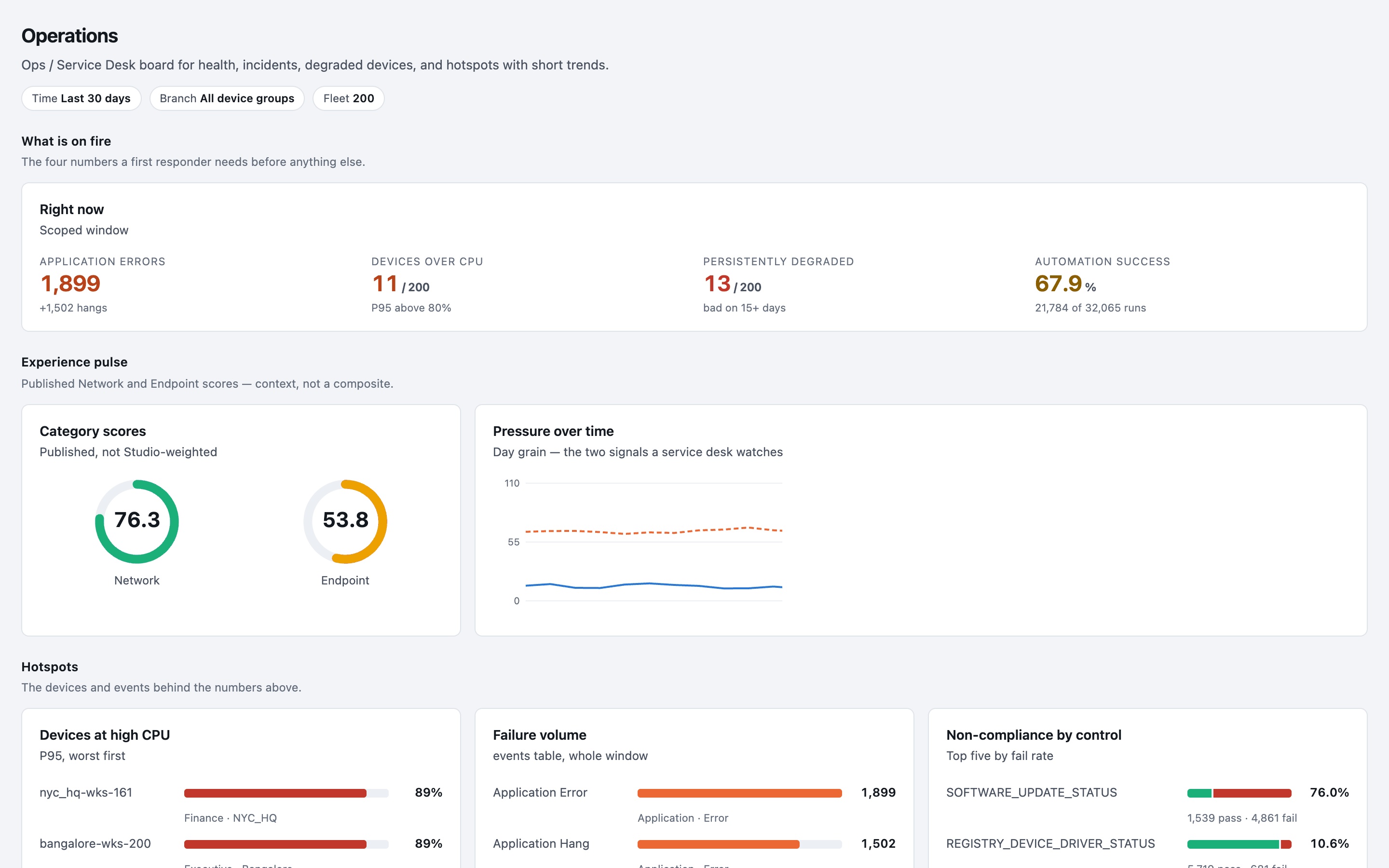
Right nowScoped window
- Application errors
- 1,899+1,502 hangs
- Devices over CPU
- 11/200P95 above 80%
- Persistently degraded
- 13/200bad on 15+ days
Ask any vendor about deflection
- When you say deflected, is the problem fixed?
- Yes. Tickets resolved on the device with no human contact are counted separately from tickets avoided, and we report both.
- Are your numbers measured or modelled?
- Both, and we keep them apart. Results are measured per automation; the business case is modelled, with every input shown. Both are on the Outcomes page.
- What happens to the tickets that still need a person?
- They open in Assisted IT with the likely cause, how many devices share it and the approved fix.
- How soon does the first ticket go away?
- In week one: we map your top call drivers to the 1,200+ fixes already in the library.
Deflection only lasts when the fault is gone, so that is what we count.